


Special and general equipment in Wreck Penetration
Άρθρο: Γιώργος Πέτρου
Photos: Greek Diver & HUE archive
In the previous issue we presented the first Wreck Diving school held by the Hellas Underwater Explorers diving school.
BASIC INFORMATION ON EQUIPMENT FOR SHIPWRECK INVASION
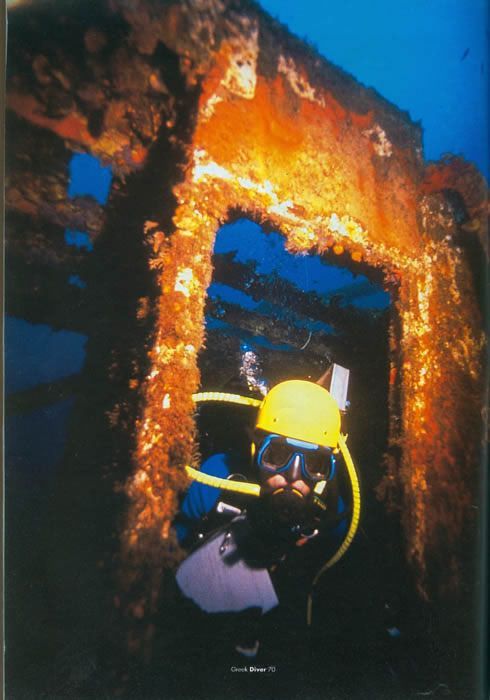
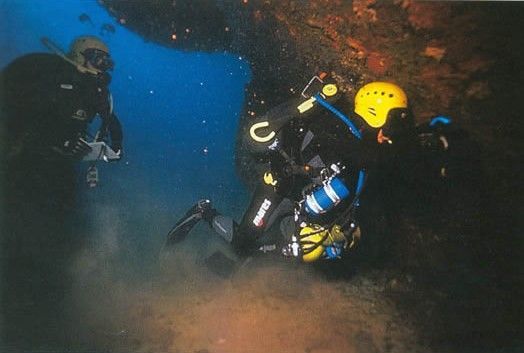
There is what we call Wreck Diving and we mean the approach around the wreck, the entry into some easy parts of the wreck and what we call Wreck Penetration which is another much more demanding and specialized situation that involves many dangers. Undoubtedly many scuba divers enter wrecks and do not face any problem. This is the goal but under some conditions it is also a trap because they have the illusion that this is simply a correct and safe Wreck Penetration.
Στο άρθρο αυτό δίνουμε βασικές πληροφορίες για την απλή Ναυαγιοκατάδυση και τίποτε παραπάνω.
Στην χώρα μας λόγω Νομικου καθεστωτος δυστυχως δεν εχουμε την δυνατοτητα να καταδυθουμε σε Ναυαγια παρα μονον με ειδικη αδεια. Τα απελευθερωμενα σημεια οπου υπαρχουν ναυαγια είναι ελαχιστα. (ήταν ελάχιστα, τώρα πια έχει αλλάξει το καθεστώς).
Παντως τα ναυαγια ηταν ανεκαθεν ένα από τα πλεον αγαπημενα θεαματα των αυτοδυτων παγκοσμιως. Ένα ποσοστο γυρω στο 90% των αυτοδυτων τρελαινεται να καταδυεται σε ναυαγια ολων των μορφων. Μεσα στο μπλε το να ανακαλυπτεις ένα φορτηγο ή ένα πολεμικο πλοιο, ένα υποβρυχιο είναι κατι το συναρπαστικο.
We want to have endless time and air so that we can visit every part of it. To travel from bow to stern, to dive into its bowels, into its holds, into the engine room... Here, it is time to distinguish Wreck Diving from the quintessence of our contact and enjoyment with wrecks, which is the internal exploration called Wreck Diving, which is the privilege of a very small percentage of divers, around 5%. When we say penetration, we do not simply mean entering a part of the wreck. When we say penetration, we mean a very, very serious process. Undoubtedly, many scuba divers enter shipwrecks and do not encounter any problems. This is the goal, but under some circumstances it is also a trap because they have the illusion that this is simply a correct and safe shipwreck entry.
Wrong, things are not like that at all. They are not in a position to know the dangers, nor to recognize them in time. The solutions to underwater problems are not recorded in their brains, because they have not been trained for them. Here we have a Special Form of Technical Diving which requires knowledge and skills of high standards. The training required is specific.
Ένα μερος των εκπαιδευτικων γνωσεων ασχολουνται με τα θετικα ή αρνητικα που απορρεουν από «περιφερειακα κομματια» του εξοπλισμου μας.
We will talk about these in this text.
"Our special & general peripheral equipment"
Some of these, when they exist, solve us, protect us from many problems, and some of them, when they exist, may create some problem for us that will lead us to a dangerous situation. We will talk about some such pieces of equipment in the text below. Let's see, then, some of these parts of our equipment that we use in a Shipwreck Infiltration will play their positive (protective), or negative (interference), role.
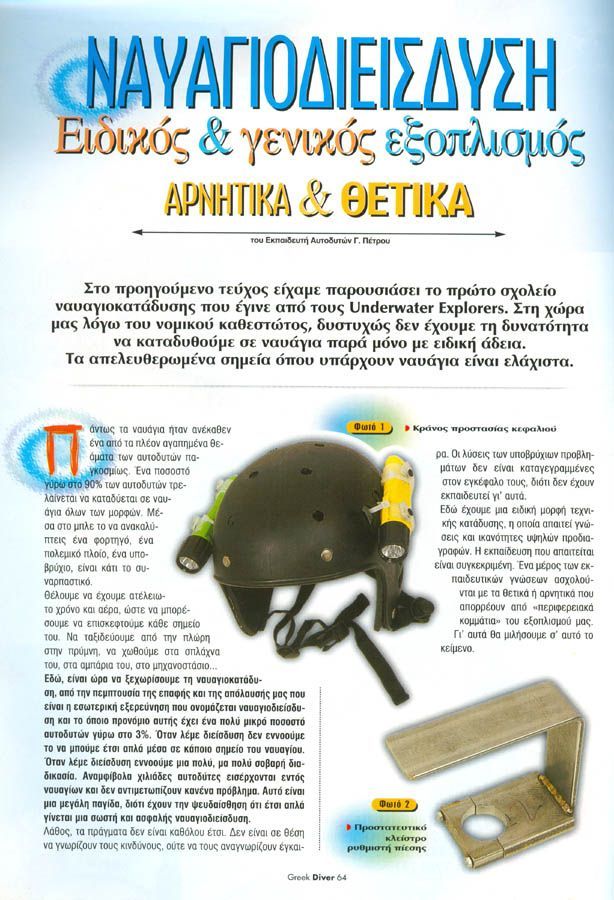
1. Head protection helmet
The most essential piece of our equipment. Penetration without a helmet is not recommended. The elements that a helmet must have are: a) be light b) have holes in the appropriate points so that air can escape and not be trapped, resulting in a lift. c) be made of such a material that it has strength and elasticity. d) be anatomically designed with a system so that it fits properly on the head and the support point on the chin. d) be so comfortable that we almost do not feel it on our head. e) protect the right points of the head g) its design allows the mask to sit well on us and not bother us. h) it should not have "closed" points where we cannot easily perform a visual and tactile inspection.
2. Προστατευτικο Κλειστρων-Ρυθμιστων Πιεσης
Εδώ παρουσιαζουμε (φωτο 2) ένα προστατευτικο τυπου "Cobra" κατασκευης UNDERWATER EXPLORERS.Είναι μια κατασκευη ακρως απαραιτητη.
It protects our valve(s) and pressure regulator from the contact that it may have at any moment inside the wreck. You can simply hit it from a wrong buoyancy control on the ceiling of the room you are diving where a piece of iron or a structure protrudes. You may not correctly calculate the passage through a door and find yourself on its upper part. An object may come loose and fall on these very important pieces of our equipment. We may be at some point where they are subjected to pressure, friction and it is a matter of time for damage to occur. Think of the case in which we hit the first stage of the pressure regulator with force and it begins to lose.
Σκεφτειτε ενας αυτοδυτης ο οποιος εχει ασυρματο Ηλεκτρονικο Υπολογιστη Αποσυμπιεσης και ο πομπος του(ο οποιος ευρισκεται στο πρωτο σταδιο) οντας απροστατευτος να χτυπησει και να παθει ζημια και να παψει να μας προσφερει
information. Disaster.
Είναι κατι παραπανω από σιγουρο ότι κατά την διαρκεια μιας διεισδυσης θα ακουμπησουμε,θα ερθουμε σε καποια επαφη στο σημειο εκεινο οπου ευρισκεται το κλειστρο/ρυθμιστης με λιγοτερη ή περισσοτερη δυναμη.Άλλες φορες θα το αντιληφθουμε και άλλες φορες όχι.Σκεφτειτε να κανουμε μια ατομικη διεισδηση και να χτυπησουμε καπου,να αρχισουμε να εχουμε απωλεια αεριου και να μην το αντιληφθουμε.Διαλυεται ολη η διαχειριση αεριων μας.Δι αυτό με λιγα λογια θεωρουμε ότι το προστατευτικο κλειστων είναι ακρως απαραιτητο.Υπαρχουν πολλοι τυποι προστατευτικων κλειστρων οπου μπορουμε κατοπιν εκπαιδευσης και εκτιμησης να διαλεξουμε.Ένα από τα σημεια που πρεπει να προσεξουμε είναι:
a) the angle of placement so that it does not prevent us from having access to the valve of the cloister b) that the protective case itself does not become entangled somewhere. c) of course you mean that it must be either made of stainless steel or aluminum.
3.Long Tube with Second Stage Octopus
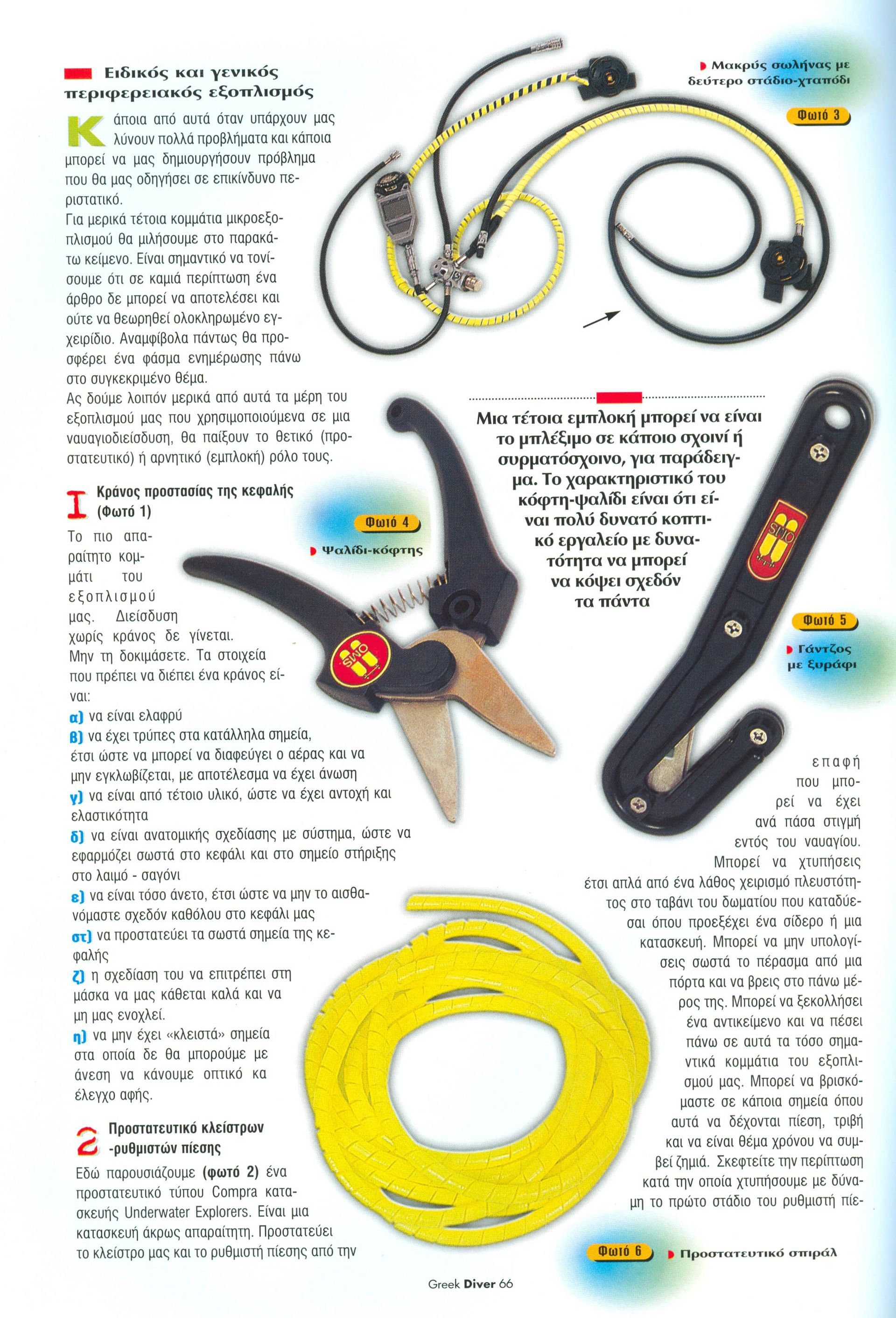
Απαραιτητα πρεπει να εχουμε έναν σωληνα το οποιο το μηκος του να είναι μεταξυ 1.5 εως και 3 μετρα.Θα αναρωτηθητε τωρα γιατι πρεπει να εχουμε τοσο μακρυ χταποδι(φωτο 3)?
*Think about when two divers have to walk through a narrow corridor of a shipwreck simultaneously, and one, having run out of air, has to take air from the other. They cannot, due to the narrowness of the space, be side by side, but the ergonomics of the space oblige them to be one behind the other.
Then for such a march to take place, one in front and the other behind, there must be a long octopus.
*If for some reason there is a narrow passage in which we have to take off our BCD and let it pass first, then a long octopus will help us move with comfort. *And of course it is understood that in the event that someone needs air but is in an inaccessible point for us, then we try to locate an opening so that we can pass our long regulator to them. To be able to give them the opportunity to calm down and find a solution to the problem.
*It is very important to ensure that the long length of the tube does not create any problem of entanglement. It must be secured in such a way that it can only be used when we want it. The choice of the point and the method of support must be done with great care.
Scissors - Cutter & Hook with razor for nets and ropes for hard-to-reach places
*Το ψαλιδι-κοφτης(φωτο 4)χρησιμοποιειται ευρεως από εταιρειες και οργανισμους κυρια τεχνικης καταδυσης οπου η αδυναμια να ανταπεξελθεις μεσα σε ελαχιστο χρονο σε καποια εμπλοκη αποτελει σοβαρο προβλημα ως προς την διαχειριση αεριων και ως προς την ψυχολογια μας.
Such an entanglement can be entanglement in a rope or wire rope, for example. The characteristic of the cutter-scissors is that it is a very powerful cutting tool with the ability to cut almost everything. *Another very important tool is the hook-razor (photo 5) which is extremely useful in cases especially where for example we have entangled in ropes or nets in a point to which we do not have easy access, such as our cloister. The design of this tool is such that with a blind reverse movement someone can cut e.g. the nets but not their pipes.
*Of course, care is required in their use so that we do not accidentally cut something that we should not cut.
5. Protective Spirals along the length of the High/Low Pressure pipes
This is one of the most inexpensive peripherals in the equipment that many people think is included for decorative reasons. Wrong!1
*First of all, it is best to use a bright color, such as yellow, given that we need to be as visible as possible. Using everything in black is not appropriate, especially when we are in a closed environment such as a shipwreck. Even a small bright spot is enough in the dark to attract attention.
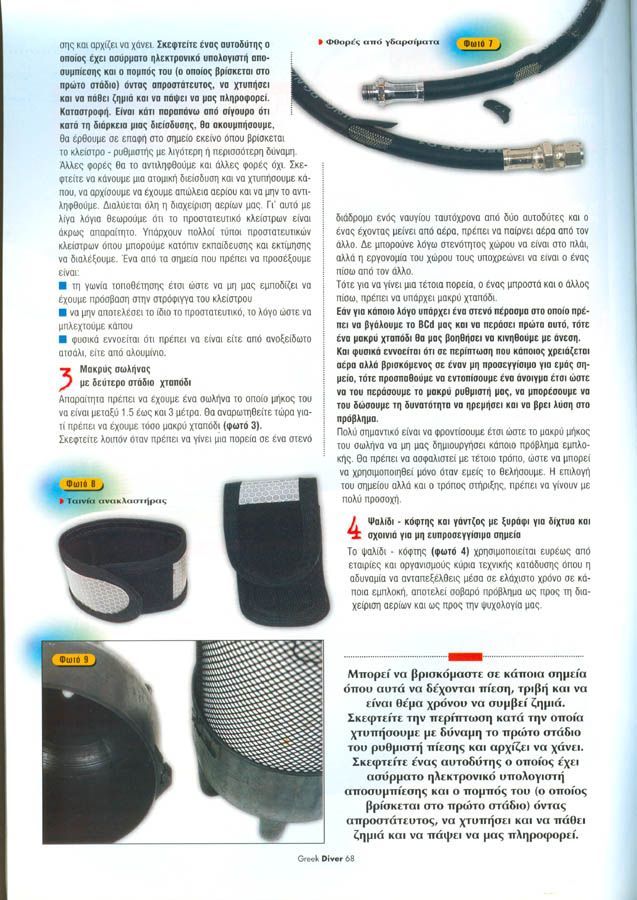
*And mainly they protect the low and high tubes from damage such as abrasions, tears. See photo 7 which shows the damage of a high tube which was not adequately protected with the very dangerous result. At the end of the dives we did that involved penetration we would see the many marks and tears that our tube protectors had.
6. Reflective Tape
And here we have a very cheap piece of equipment that we mainly find on buoyancy regulators. In our activity in Wreck Penetration this detail is likely to play a very important role. *Think of a diver whose flashlight has gone out (and unfortunately not having another backup system), trying to find the exit in the dark. At that moment his partner is looking for him by illuminating the dark rooms of the wreck where even a reflection of light will help in locating him..
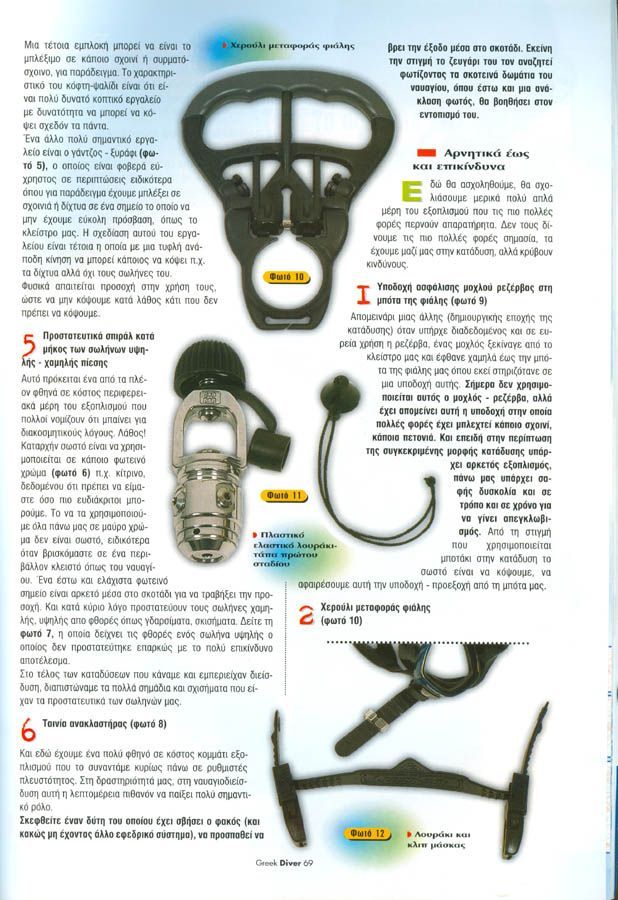
2. Χερουλι Μεταφοράς Φιάλης
We all know about these very convenient and useful handles that help us carry the tank that tires us so much. Although it is ridiculous, but because I have seen it, I have to point out that under no circumstances should this piece of equipment be on us during such a dive. One thing is for sure, it will get tangled somewhere and we will stupidly risk it.
3. Plastic/Elastic First Stage Strap-Stopper
None of us take it out, and we carry it with us on all our dives. Who thinks that this too can get tangled somewhere? No one!! And yet unfortunately this too has been found to cause dangerous situations just because it got tangled somewhere, because it got stuck, some line or rope got wrapped around it. Precious time for our extrication was lost.
4. Λουρακια & Κλιπ Μάσκας και Πέδιλων
Τα λουράκια από την μάσκα μας και τα πέδιλα μας θα πρέπει να, πιασμένα με ταινία έτσι ώστε να μην προέχουν και πιαστούν σε οποιαδήποτε σχισμή. Σε συγκεκριμένη κατάδυση είχαμε το περιστατικό κατά το οποίο ο εκπαιδευόμενος αυτοδύτης κάνοντας μια διείσδυση / άσκηση βίωσε τον μίτο του σε ανύποπτο χρόνο που τον χαλάρωσε κατά λάθος αυτός να περνάει και να τυλίγεται στο προεξέχοντα κλιπ που περνάμε το λουράκι της μάσκας!!!!!!
Συνέβη και αυτό.
5. Rotary ON-OFF Switch for our Helmet's Small Flashlight
Beware of these very good flashlights from all points of view. They have a negative peculiarity for this specific activity which is none other than that to turn on the flashlight you have to rotate the front of the flashlight in one direction. This means that if you have to turn it on quickly (because the main flashlight suddenly went out) and your good hand is necessarily busy, then with the other hand you have to hope that no rotation in the opposite direction and your flashlight breaks!!!!! Underwater. The right thing is for such application flashlights to have an ON-OFF switch. Simple as that.
6. Dry Suit
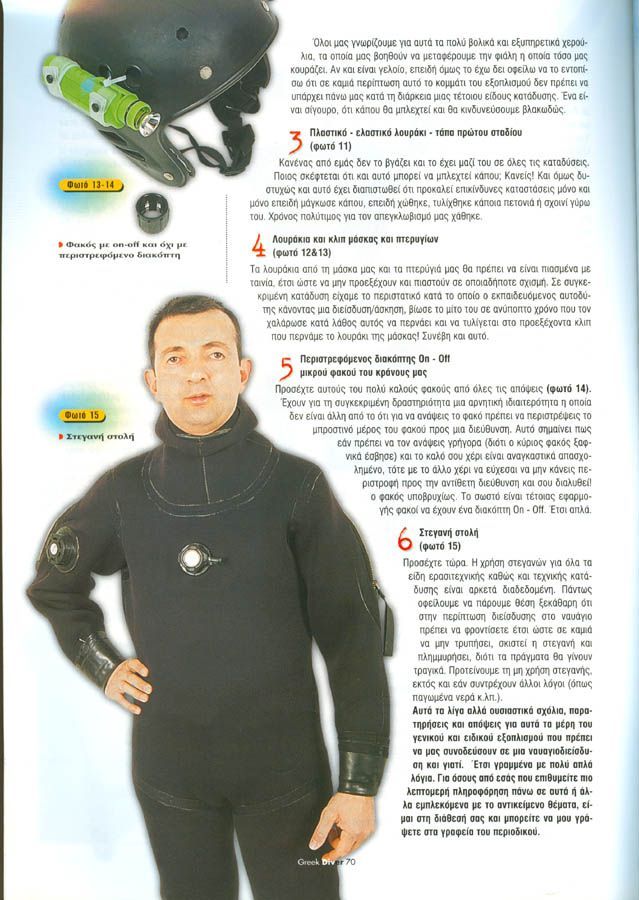
Be careful now. The use of waterproofs for all types of amateur and technical diving is quite widespread. However, we must take a clear position that in the event of a shipwreck penetration, you must take care that under no circumstances does the waterproofing get punctured, torn and flooded because things will become tragic. We recommend not using a waterproofing, unless there are other reasons (such as icy waters, etc.).
It is important to emphasize that under no circumstances can an article constitute or be considered a complete manual.
Publications
Share this