


Compass Basics
Underwater navigation & orientation
Αρθρογράφος: Γιώργος Πέτρου Instructor Trainer TDI, SDI. PADI MSDT, CMAS / ΕΟΥΔΑΑΤΚ 3***.
Φωτογραφίες: Ευγενική παραχώρηση PADI, αρχείο Greek Diver, HUE
BASIC ELEMENTS OF PYXIDA
"Loss of orientation underwater can alter
μια κατάδυση αναψυχής σε μια πολύ δυσάρεστη και επικίνδυνη κατάσταση.
Imagine being swept away by the current and finding yourself in the middle of the ocean.
"Imagine getting out very far from the exit point and having to walk in your suit on the rocks."
Η Πυξίδα δυστυχώς ήταν και είναι ένα πολύ υποτιμημένο και παραμελημένο θέμα στη κατάδυση. Ειδικής μορφής εκπαίδευση θα έλεγα στην οποία δεν επιμένουν οι εκπαιδευτές και δεν εξασκούνται οι αυτοδύτες. Όταν μας χρειαστεί και δεν είμαστε ικανοί να την χρησιμοποιήσουμε αποτελεσματικά ένα είναι σίγουρο ότι θα μπούμε σε περιπέτειες κινδύνου και ταλαιπωρίας. Στο άρθρο αυτό αναφέρουμε βασικά στοιχεία πυξίδας που απαιτείται κατ΄ ελάχιστο να κατέχει ο οποιασδήποτε βαθμίδας αυτοδύτης.
"Caution: under no circumstances is the information mentioned in this article sufficient for use by untrained individuals. Any use of it should be made by scuba divers certified in the specialty of Underwater Orientation and under their responsibility.
We are increasingly realizing that:
• Υποβαθμίζεται στα σχολεία εκπαίδευσης αυτοδυτών η διδασκαλία με στόχο την απόκτηση γνώσης και πρακτικής χρήσης Πυξίδας αλλά και ευρύτερα του υποβρύχιου προσανατολισμού.
• Scuba divers do not feel the need to acquire knowledge and practical use of a compass.
• After completing their schooling, scuba divers never deal with anything related to a compass again and unfortunately, they do not practice using it.
• When scuba divers try to make a compass, most of the time the results are negative.
And of course because they don't know a compass and don't stray far from the beach.....
What is a compass?
It is a part of our equipment that helps us orient ourselves either on land or underwater. It has the property of "pointing" to Magnetic North.
Οι κύριοι λόγοι που χρησιμοποιούμε πυξίδα είναι:
1. To get from point to point in the fastest, safest and shortest way. 2. To make a multi-directional route and have the ability to return to the point from which we started. 3. To conduct research in the most organized way. 4. To save gas. 5. To have predetermined data on our underwater course. 6. To feel safe. 7. It is our only option (besides vertical ascent) when we are disoriented in the blue.
A compass basically consists of:
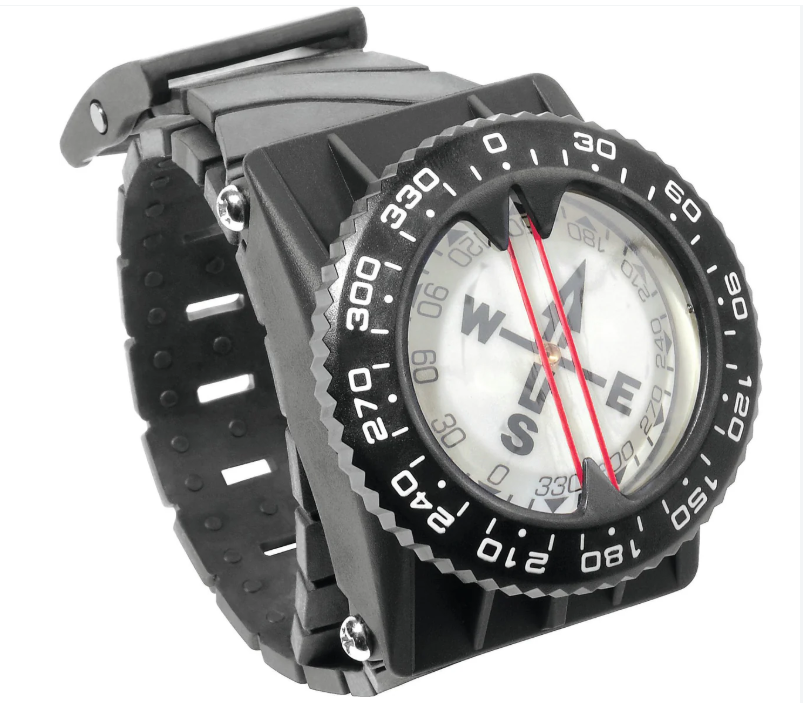
• A plastic/elastic case (to place the capsule inside) with elastic or fabric straps (to attach to our wrist)
• Μια κάψουλα η οποία εμπεριέχει
* Υγρό, συνήθως Γλυκερίνη
* Μία κάθετη ακίδα
* Ένα δίσκο ο οποίος περιστρέφεται πάνω στην ακίδα και έχει σημειωμένο πάνω του τον διαχωρισμό του ορίζοντα σε μοίρες από τις 0ο έως τις 360ο.
• Μία περιστρεφόμενη "καστάνια" η οποία και αυτή έχει σημειωμένη πάνω της τον διαχωρισμό του ορίζοντα σε μοίρες από τις 0ο έως τις 360ο. Το σύμβολο της μοίρας είναι η τοποθέτηση στην δεξιά πάνω γωνία του αριθμού π.χ. 180 ένα μικρό "ο". Για παράδειγμα 180ο . Στην καστάνια αυτή υπάρχουν πλαστικές προεξοχές που δύνανται να προσδιορίσουν, εγκλωβίσουν οποιοδήποτε συγκεκριμένο σημείο (μοίρες) του ορίζοντα
• A sighting window.
• Μία γραμμή σκόπευσης
There are 2 basic types of compass:
1. The analog compass 2. The digital compass In this article we will deal with the compass from the perspective of using the analog one.
Τα σχήματα, οι βασικές πορείες διευθύνσεις της χρήσης πυξίδας είναι:
• <->ευθεία πορεία και επιστροφή
• Equilateral triangle
• Isosceles rectangle
• Square
• Parallelogram
Φυσικά και μπορούν να εφαρμοστούν και άλλα σχήματα αλλά όσο πιο απλό και δεδομένο είναι ένα σχήμα - διεύθυνση πορείας, τόσο πιο πολλές πιθανότητες επιτυχίας έχουμε. Σχήματα όπως Σκαληνό, Ρόμβος, Οκτάγωνα κλπ δεν είναι ιδανικά προς εφαρμογή.
Mathematical calculations
Straight path and return
Let's assume that we take a straight path and at some point we stop and wish to return to the same point from which we started,
Example No. 1: I go from point A to point B at 100 degrees
I return from point B to point A by adding or subtracting 180 degrees.
So in the case of adding the operation is as follows: 100° 180° = 280° degrees in the case of subtracting however we notice that upon reaching zero we begin to subtract from 360°. Let's see step by step the evolution of the operation 100° - 180° 100° - 100° = 0/360° and then 360° - 80° = 280° To simplify it the operation becomes: 100° - 180° 360° = 280°
Example No. 2: I go from point A to point B with 260 degrees
I return from point B to point A by adding or subtracting 180 degrees.
The easy choice in this case is a case of subtraction, so: 260° - 180° = 80° In the case of addition, the operation is as follows: 260° 180° - 360° = 80°
"Rule" To return to the point from which we started (in a straight line) we either add or subtract 180°. If<180ο προσθέτουμε. Εάν > 180th we subtract
Isosceles rectangle
We have a right isosceles triangle. Our course GA is 140 degrees and clockwise. Let's calculate the courses AB & BG.
140th
Σε ορθογώνιο ισοσκελές τρίγωνο οι εσωτερικές γωνίες είναι : Γ = 90ο Α = 45ο Β = 45ο
Και οι εξωτερικές δεξιόστροφες διορθώσεις είναι: Γ = + 90ο Α = + 135ο Β = 135ο
So our courses are: GA = 140° AB = 140° 135° = 275° BG = 275° 135° - 360° = 50° Confirmation: GA = 50° 90° = 140°
"Rule" - In a right-angled isosceles triangle to calculate a clockwise course we add 90° 135° 135° - In a right-angled isosceles triangle to calculate a counterclockwise course we subtract - 90° - 135° - 135°
Equilateral triangle
Έχουμε ένα ισόπλευρο τρίγωνο. Η πορεία μας ΒΑ είναι 35 μοιρών και Αριστερόστροφη.
Ας υπολογίσουμε τις πορείες ΑΓ & ΓΒ
Σε ισόπλευρο τρίγωνο οι εσωτερικές γωνίες είναι : Γ = 60ο Α = 60ο Β = 60ο
Και οι εξωτερικές δεξιόστροφες διορθώσεις είναι: Γ = - 120ο Α = - 120ο Β = - 120ο
So our courses are: NE = 35° AG = 35° - 120° 360° = 275° GB = 275° - 120° = 155° Confirmation: NE = 155° - 120° = 35°
"Rule"
- Σε ισόπλευρο τρίγωνο για τον υπολογισμό δεξιόστροφης πορείας προσθέτουμε
+ 120ο + 120ο + 120ο
- Σε ισόπλευρο τρίγωνο για τον υπολογισμό αριστερόστροφης πορείας αφαιρούμε
- 120ο - 120ο - 120ο
Προβλήματα κατά την πυξίδα
The possible problems (some) that may arise when making a compass are:
1. The compass is not working properly. We must be sure that our compass is working properly. 2. There are no objects that are not magnetized / affecting. 3. The diver is not keeping the course steady. If the observance of the degrees of the course is not maintained, the compass course will not be accurate. The problem occurs in divers who have not practiced enough in using a compass. 4. There is a lateral displacement due to: - stronger pedaling of one leg. This is a problem that we cannot detect during the dive. - strong current. The case of the presence of a current is a serious factor that will undoubtedly contribute to the failure of our compass if we do not make the necessary corrections (adding or subtracting degrees). Caution: in the event of a lateral, parallel to the desired course, course, our indication will remain the same but we will "come out" at a point other than the desired one. 5. Loss of partner. This is a common problem that unfortunately occurs in pairs of scuba divers because the one who is doing the compass: - has an almost ideal hydrodynamic position, resulting in swimming quickly - has an almost absolute commitment to the success of the compass, concentrates on it and does not pay attention to his partner. 6. Loss of Buoyancy. This is a serious problem and the scuba diver should be especially careful, it is likely to happen when we are doing a shallow mid-ocean course.
Ειδικές ασκήσεις
Υπάρχουν άραγε ειδικές ασκήσεις που μπορούμε να κάνουμε έτσι ώστε να γίνουμε καλοί στην πυξίδα? Όχι, το μυστικό είναι να κάνουμε συχνά χρήση πυξίδας, να εξασκούμαστε στα βασικά σχήματα ευθεία /επιστροφή και φυσικά σε τρίγωνη πορεία.
Πάντως μια πολύ χρήσιμη και "διδακτική" είναι η άσκηση "Σταυρός".
Αυτή πραγματοποιείται ως εξής: Πραγματοποιούμε πυξίδα σε ένα ρηχό βάθος π.χ. βάθος 6 μέτρων σε καταδυτικό σημείο όπου δεν διακρίνεται ο πυθμένας ή άλλο σημείο συσχέτισης προσπαθώντας να διατηρήσουμε βάθος και διεύθυνση (μοίρες) ταυτόχρονα.
Consumption Another point that we should pay attention to is our gas consumption. Often when making a compass we are so focused on it that we do not check the vital factor of our air adequacy.
Vertical Compass Finally, a very useful tip is to apply the so-called "Vertical" compass. Applying this will result in "seeing/reaching" land as soon as possible.
Publications
Share this