


Night diving
Columnist: George Petrou
Photo: Dinos Symeonidis and Giorgos Vandoros
Νύχτα, το ασημένιο φως του φεγγαριού δημιουργεί μια άλλη αίσθηση, του άλλου πλανήτη. Η διάχυσή του γύρω μας εμφανίζει σκιές και κάνει το περιβάλλον θεατρικό. Αλλάζει τις διαστάσεις. Η έλλειψη του φεγγαριού αποδίδει την αληθινή , σκοτεινή εικόνα του βυθού την νύχτα. Απόλυτο σκοτάδι, ορατότητα έως εκεί που κατακτούν τα μόρια του τεχνητού φωτισμού του φακού μας.
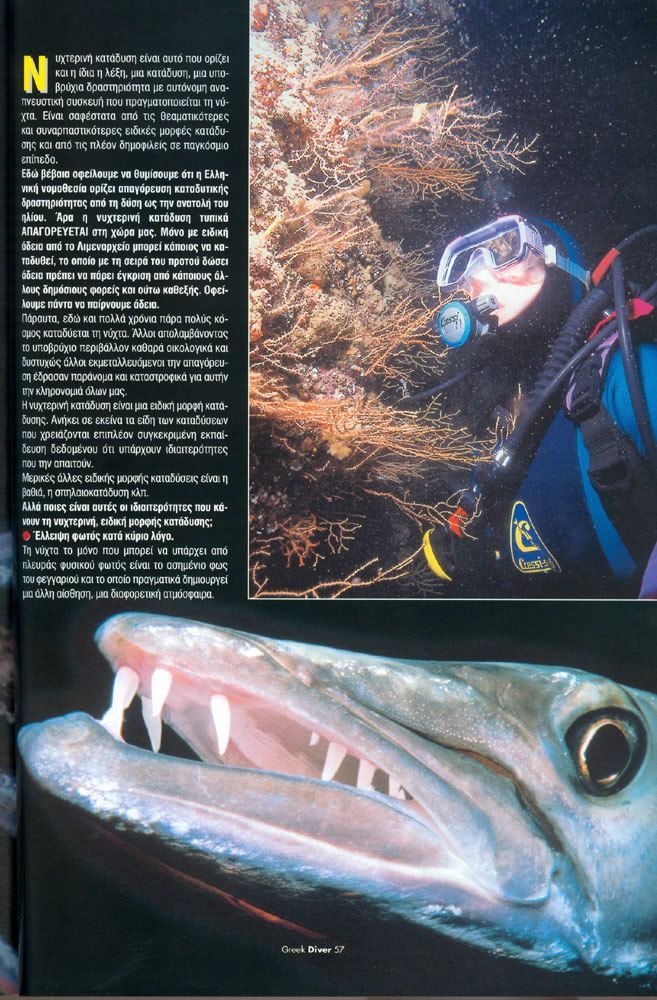
The environment takes on another entity, a wonderful, wild spectacle. At night, many aquatic creatures appear that we will not see during the day. They come out to hunt.... Crustaceans, octopuses, night plants, fish that sleep in the air. The shimmering plankton enchants us. The bubbles are illuminated by the moon as they emerge.
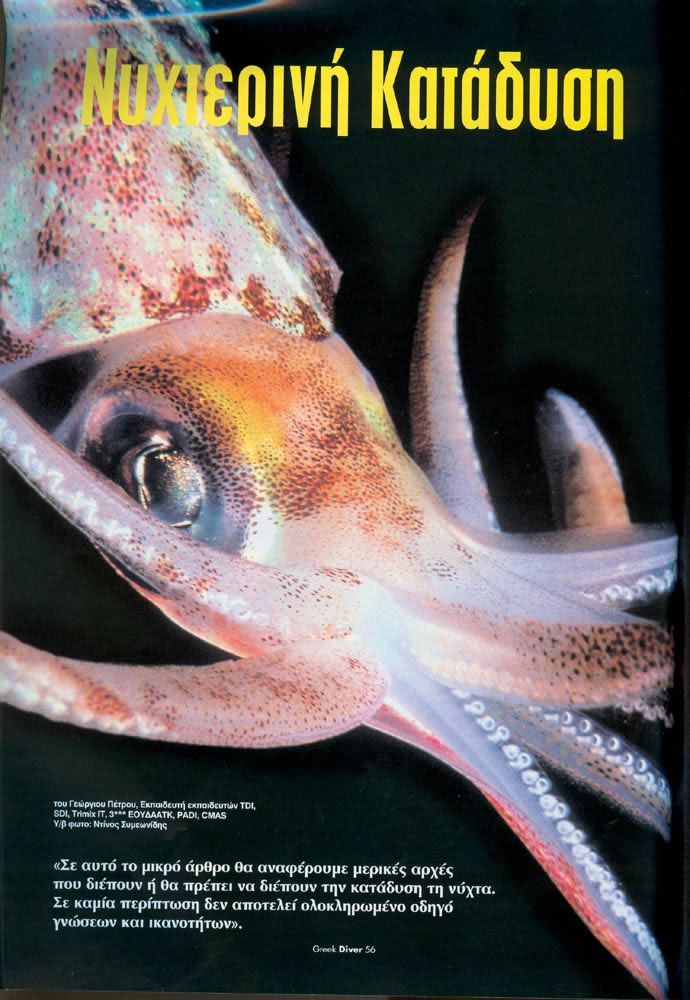
"In this short article we will mention some principles that govern or should govern night diving. It is by no means a comprehensive guide to knowledge and skills."
Night diving is what the word itself defines, a dive, an underwater activity with autonomous breathing apparatus that takes place at night. It is clearly one of the most spectacular and exciting special forms of diving and one of the most popular worldwide.
Here, of course, we must remember that Greek law prohibits diving from sunset to sunrise. So night diving is formally PROHIBITED in our country. Only with a special permit from the Port Authority can someone dive, which in turn must obtain approval from other public bodies before granting permission and so on. We must always obtain permission. However, for many years now, too many people have been diving at night. Others, enjoying the underwater environment purely ecologically, and unfortunately others, taking advantage of the ban, have acted illegally and destructively for this heritage of all of us.
Night diving is a Special Form of diving. It belongs to those types of diving that require additional specific training since there are specificities that require it.
Some other special forms of diving are deep, or compass, cave diving, etc.
But what are these peculiarities that make Night diving a special form of diving?
• Έλλειψη φωτός κατά κύριο λόγο.
At night, the only natural light that can exist is the silver light of the moon, which really creates another sensation, a different atmosphere. Its diffusion around us creates shadows and makes the environment charming. It changes all dimensions. The lack of moonlight gives the true, dark image of the seabed at night. Absolute darkness, limited visibility up to where the particles of artificial lighting in our lens reach. The environment acquires another dimension, it becomes different and new.
• Our psychology is negatively affected by absolute or almost absolute darkness. When we gain experience and adapt, our psychology is positively affected.
• Κρύο
Εννοείται ότι το βράδυ η θερμοκρασία πέφτει γεγονός το οποίο είναι αρνητικό για την φυσιολογία μας και την ασφάλεια της κατάδυσης. Είναι απαραίτητη η θερμική μας προστασία.
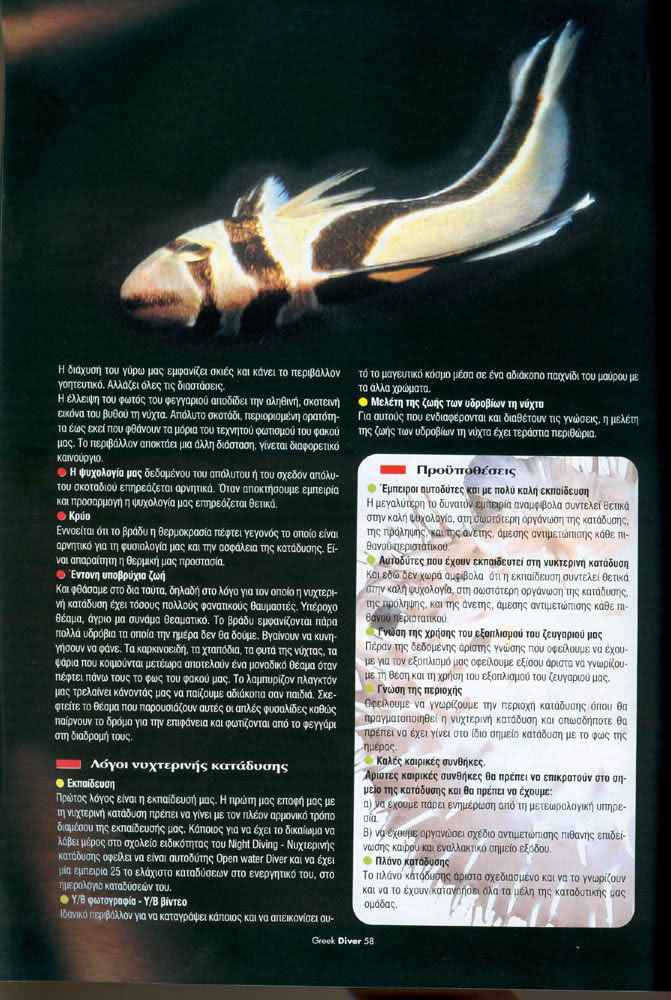
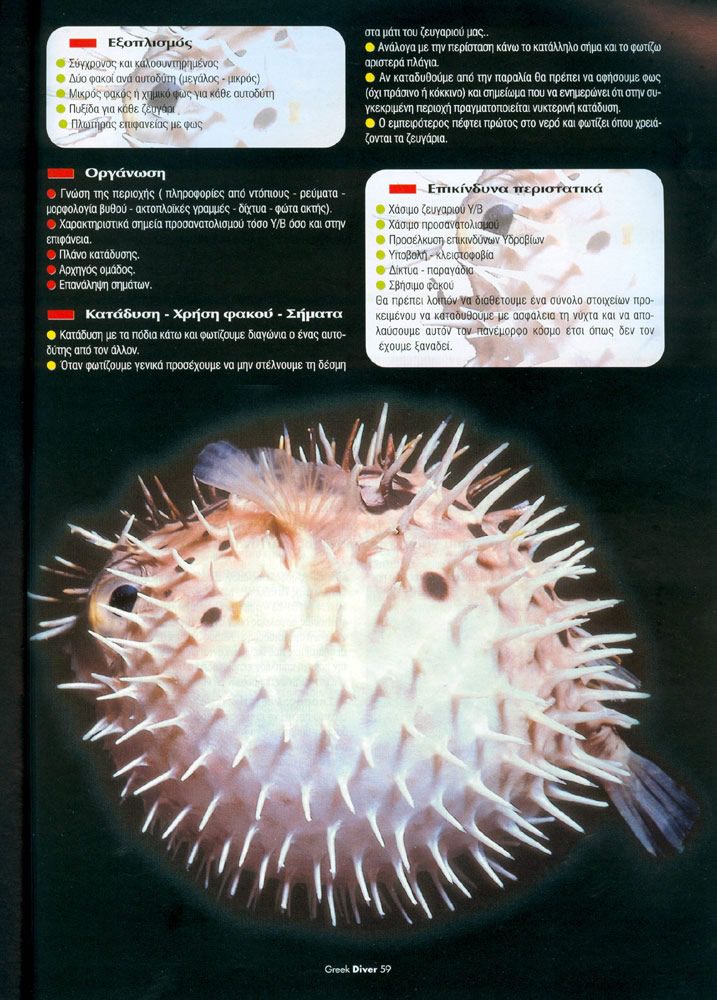
• Intense underwater life And we have reached the point, that is, the reason why night diving has so many fanatical fans. A wonderful sight, wild but at the same time spectacular. At night, many aquatic creatures appear that we will not see during the day. They come out to hunt and eat. The crustaceans, octopuses, night plants, fish that sleep in the air constitute a unique spectacle when the light of our flashlight falls on them. The shimmering plankton drives us crazy, making us play incessantly like children. Think of the spectacle presented by these simple bubbles as they make their way to the surface and are illuminated by the moon on their way.
Reasons for Night Diving
• Education The first reason is our education. Our first contact with night diving must be done in the most harmonious way through our education. In order to have the right to take part in the Night Diving specialty school, someone must be an Open water Diver and have a minimum of 25 dives in their dive log.
• B/W photography - B/W Video An ideal environment for someone to record and depict this magical world within a continuous play of black with other colors.
• Μελέτη της ζωής των υδροβίων την νύχτα
Για αυτούς που ενδιαφέρονται και διαθέτουν τις γνώσεις η μελέτη της ζωής των υδροβίων την νύχτα έχει τεράστια περιθώρια.
Conditions
• Experienced and well-trained scuba divers
The greatest possible experience undoubtedly contributes positively to good psychology, to the correct organization of diving, to prevention, and to the comfortable, immediate response to any possible incident.
• Αυτοδύτες που έχουν εκπαιδευτεί στην Νυκτερινή κατάδυση
Και εδώ δεν χωρά αμφίβολα ότι η εκπαίδευση συντελεί θετικά στην καλή ψυχολογία, στην σωστότερη οργάνωση της κατάδυσης, της πρόληψης, και της άνετης, άμεσης αντιμετώπισης κάθε πιθανού περιστατικού.
• Knowledge of the use of our partner's equipment In addition to the given excellent knowledge that we must have about our equipment, we must equally know the location and use of our partner's equipment.
• Knowledge of the area
We must know the diving area where the night dive will take place and a dive in daylight must have been done at the same spot.
• Good weather conditions Excellent weather conditions should prevail at the dive site and we should have: a) received information from the Meteorological Service. B) organized a plan to deal with possible worsening weather and an alternative exit point.
• Πλάνο κατάδυσης
Το πλάνο κατάδυσης άριστα σχεδιασμένο και να το γνωρίζουν και να το έχουν κατανοήσει όλα τα μέλη της καταδυτικής μας ομάδας.
Equipment
• Modern and well-maintained
• Δύο φακοί ανά αυτοδύτη (Μεγάλος - Μικρός)
• Small flashlight or chemical light for each diver
• Compass for each couple
• Surface float with light
Organization
• Knowledge of the area (information from locals – currents – seabed morphology – coastal shipping lines – nets – coastal lights).
• Characteristic orientation points both underground and on the surface.
• Πλάνο κατάδυσης
• Αρχηγός ομάδας
• Signal repetition
Κατάδυση - Χρήση φακού - Σήματα
• Κατάδυση με τα πόδια κάτω και φωτίζει διαγώνια ο ένας αυτοδύτης από τον άλλον.
• When I light, I generally take care not to direct the beam into my partner's eyes.
• Depending on the situation, I make the appropriate signal and illuminate it on the left side.
• If we dive from the beach, we must leave a light (not green or red) and a note informing that night diving is taking place in this specific area.
• The most experienced person jumps into the water first and lights up where the couples need it.
Dangerous incidents
• Loss of a pair of Y/B
• Loss of orientation
• Attracting dangerous aquatic life
• Υποβολή - κλειστοφοβία
• Nets - longlines
• Flashlight off
We should therefore have a set of elements in order to dive safely at night and enjoy this beautiful world.
Publications
Share this