


Hypothermia & Scuba Diving
Άρθρο: Γιώργος Πέτρου
Photos: Orestis Karamanos, Giorgos Petrou & Greek Diver archive
In the last few issues, as you may have noticed, we have started to cover issues that indirectly but clearly, but also directly affect our favorite activity, diving. In this article, we will deal with a very classic issue, problem, "Hypothermia".
Diving should never cease to be an enjoyable and safe activity. Two inviolable conditions. Is there a situation that automatically violates both of the above conditions? Yes!! Hypothermia. And to be more precise, the situation that the scuba diver experiences before reaching Hypothermia. He begins to get very cold and this negatively, painfully and dangerously affects all his organic systems. In this article we present basic information about the pre- and post-Hyperthermia state.
There is no person who has not experienced the unpleasant sensation caused by a very cold environment. But what happens when this drop in the temperature of the external environment begins to have a particular impact on the internal "environment", on the human body? His previously pleasant personal activity will begin to become not only not enjoyable but also torturous.
The drop in the normal value of the internal temperature poses a great danger to human life. Exposure to cold in a decade caused about 7,450 deaths, most of which were due to hypothermia. Accidental hypothermia is caused by prolonged exposure to cold, in an open space or outdoors, especially when there is humidity and when it is windy. The wind can cause much colder than the surrounding air. Fatalities from falling into icy water are more likely to be caused by hypothermia than by drowning. When the body is surrounded by cold water, it freezes (loses temperature) 30 times faster than when it is surrounded by cold air. And it can reach a dangerously low internal temperature much faster.
What is the normal value of our internal temperature?
Η κανονική θερμοκρασία μας, πρέπει να ευρίσκεται στους 36,6 με 36,7 βαθμούς C (Κελσίου).
Τι ονομάζεται Υποθερμία?
Hypothermia is defined as the condition that occurs when the core body temperature (tympanic membrane, esophagus, rectum) is <35°C. It is classified as mild hypothermia if the core body temperature is 34-35°C, as moderate when it is 30-34°C, and as severe if the temperature is <30°C. It is also classified as primary (result of exposure to a cold environment) and secondary (dysfunction of the hypothalamus thermoregulation).
Hypothermia is essentially the condition in which a human is unable to compensate for lost temperature. Hypothermia affects all organ systems.
Affected Systems
Endocrine Glands / Metabolism Cardiovascular Nervous Skin / Exocrine Glands
Pathophysiology
Η πρωιμότερη διαταραχή που συμβαίνει στην ήπια υποθερμία είναι ή αύξηση του όγκου του αίματος κεντρικώς λόγω της περιφερικής αγγειοσύσπασης. Σε άτομα με οριακή καρδιακή λειτουργία, αυτή η αύξηση είναι ικανή ενδεχομένως να προκαλέσει πνευμονικό οίδημα. Η αύξηση του όγκου του αίματος κεντρικώς παρασύρει σε διούρηση εκ ψύχους το αποτέλεσμα της οποίας είναι πραγματική και σημαντική απώλεια ενδοαγγειακού όγκου. Αν αναπτυχθεί βαριά υποθερμία, η διούρηση επιτείνεται προκαλώντας παραπέρα απώλεια ενδοαγγειακού όγκου.
The loss of intravascular volume results in hemoconcentration and increased blood viscosity. This may explain the increased thrombosis in the coronary vessels and the CNS observed at low ambient temperatures. Other hematological disorders that have been reported are thrombocytopenia and disseminated intravascular coagulation. Cardiac output and heart rate initially increase with exposure to cold but progressively decrease as core temperature falls. At temperatures <32°C the arterial pulse is difficult to palpate.
Cerebral metabolism and cerebral blood flow are reduced by hypothermia. The concomitant increase in blood viscosity further affects cerebral microcirculation. Nerve conduction is slowed, leading to reduced reflexes. The pupillary response is sluggish and eventually disappears. In severe hypothermia, the victim may appear clinically dead. Patients with core temperatures as low as 17°C have been revived!!! Attempts to resuscitate the patient should not be influenced by their clinical appearance and should not be stopped until the core temperature reaches at least 30°C.
The effects of progressive hypothermia on the respiratory system include increased bronchial secretions, respiratory depression, pneumonia, and decreased cough reflexes due to decreased level of consciousness. Hypothermic tissues have decreased oxygen requirements. This decrease in metabolic rate and tissue O2 requirements may explain the survival of some hypothermic patients after prolonged cardiopulmonary arrest. Gastrointestinal motility is reduced. All hepatic functions, including clearance of administered drugs and utilization of glucose, are depressed. Pancreatitis is common.
Insulin secretion is reduced by body cooling, while peripheral glucose uptake is suppressed. The result is marked hyperglycemia. These abnormalities are reversed by rewarming. Exogenous insulin administration to hypothermic patients is ineffective until rewarming occurs.
Mechanisms
a) Due to conduction, when a hotter substance comes into contact with a colder substance, their temperatures tend to equalize. In fact, the temperature of the human body constantly tends to equalize with the temperature of the environment.
b) The body tries to regulate, replenish, its lost temperature, and maintain a constant temperature of 36.6 - 36.7 degrees C.
Therefore:
1. Παραγωγή θερμοκρασίας
2. Απώλεια θερμοκρασίας
3. Διαταραχή θερμορύθμισης
What factors influence us / predisposing factors?
Malnutrition Immersion in cold water Accident Alcohol. Alcohol abuse affects behavior. It causes vasodilation in the skin, anesthesia and often Hypoglycemia. Skin diseases Liver failure Sepsis Burn Bronchopneumonia Extensive fluid loss Cigarette Lack of sleep Inadequate shelter Inadequate clothing Wet and exposed to strong cold winds (in combination with the time factor) Thin person Old age Fatigue, exhaustion Poor psychology Poor circulation Endocrine diseases (Hypothyroidism, Hypoglycemia, pituitary insufficiency, adrenal insufficiency) CNS (Central Nervous System) & Hypothalamus dysfunction Drug poisoning (barbiturates, phenothiazines, cyclic antidepressants, narcotics, parasympatholytics, benzodiazepines) Spinal cord injury at the level of the 1st thoracic vertebra (disruption thermoregulation). Heart disease Lack of knowledge, respect, self-esteem and bad mentality.
How long can the human body replenish lost temperature?
As long as ideal conditions exist, in non-ideal conditions, each person has their own personal limits.
Όταν έχουμε εσωτερική πτώση της θερμοκρασίας του σώματος ποία τα σημάδια και συμπτώματα?
Mild Hypothermia (34° - 35° C)
1. Lethargy 2. Mild Confusion 3. Movement asynergy 4. Drop in pulse & blood pressure 5. Peripheral vasoconstriction
Moderate Hypothermia (30° - 34° C)
1. Delirium 2. Bradycardia 3. Hypotension 4. Cyanosis 5. Arrhythmias 6. Hemicoma and Coma 7. Muscle rigidity 8. Decreased reflexes 9. Generalized edema 10. Hypoventilation
Severe Hypothermia (<30°C)
1. Very cold skin 2. Rigidity Apnea 3. Absence of pulse 4. Asystole 5. Ventricular fibrillation 6. Absence of reflexes 7. Fixed pupils
Hypothermia Occurrence Rate
Ο ρυθμός εμφάνισης υποθερμίας (Κεντρική Πτώση θερμοκρασίας) σε ένα άτομο που το γυμνό του σώμα είναι εκτεθειμένο σε κρύο νερό είναι:
Liquid temperature (°C)
Hypothermia rate (°C/1 hour)
20 (68°F) 0.5
15 (59ο F) 1,5
10 (50°F) 2.5
5 (41st F) 4
0 (32ο F) 6
Πώς αντιμετωπίζουμε μια κατάσταση υποθερμίας?
General Measures
1. Διατήρηση ζωτικών σημείων, εξασφάλιση αναπνοής / Διασωλήνωση εάν χρειάζεται / χορήγηση θερμού, υγροποιημένου Ο2 / διόρθωση μεταβολικής οξέωσης.
2. Έλεγχος για κρυοπαγήματα
3. Επαναθέρμανση σταδιακά (ο ρυθμός της Επαναθέρμανση πρέπει να είναι 0.5 - 2ο C ανά ώρα. Αν τυχόν είναι ταχύτερος μπορεί να προκαλέσει κοιλιακή μαρμαρυγή και υποογκαιμική καταπληξία)
4. Σε όλους τος ασθενείς:
- αφαίρεση ρούχων (φόρεμα ζεστών)
- προστασία από απώλεια θερμότητας και ψυχρό αέρα
- οριζόντια θέση
- παρακολούθηση θερμοκρασίας και καρδιακού ρυθμού.
Mild measures
1. Passive rewarming (warm blankets and clothing) 2. Intravenous administration of warm fluids (45°C) 3. Warm fluids can be drunk by patients who are fully alert 4. Active external rewarming 5. Heated blankets and pillows
Ειδικά μέτρα
1. Peritoneal dialysis 2. Warm fluid 3. Thoracic cavity lavages 4. Extracorporeal blood rewarming 5. Gastrointestinal lavages. Enemas etc. with warm fluids
Τι δεν πρέπει:
1. Rewarm quickly 2. Place heating pads near the victim because blood flow is accelerated and a delayed decrease in core body temperature can occur as cold blood returns from the body surface. 3. No alcohol 4. No cigarettes 5. No coffee
Dive
After we have talked enough about the topic, let's get to the heart of the matter that interests us.
What factors affect us when diving? (besides those mentioned above)
Diving in low temperature water Lack of a wetsuit!!! Unsuitable wetsuit a) in terms of the temperature conditions (cold) of the environment b) in terms of its application to the diver's body Deep diving Deep diving means lower temperature, greater compression of the Neoprene and the obligation for a longer time for denitrification. Underwater currents Diving in a lake, rivers, on ice Heavy work
Amateur diving that does not exceed the limits of the "0" hour
Προτείνεται πάντα και για όλους. Όσο παραμένουμε εντός των ορίων της ώρας 0 ανά πάσα στιγμή κάνοντας μια αργή ανάδυση και την υποχρεωτική αποσυμπίεση για προληπτικούς λόγους μπορούμε να αναδυθούμε στην επιφάνεια.
Technical Diving that requires a long time of decompression (deco)
Το πρόβλημα εδώ είναι σοβαρό, από το οποίο απορρέουν δύο ερωτήματα:
1. Τι θα κάνω εάν αρχίζω και κρυωνω αρκετά ενώ μου υπολείπεται πολύς χρόνος αποσυμπίεσης? Εάν συνεχίσω κινδυνεύω για υποθερμία ή μη σωστή απαζώτοση.Εάν αναδυθώ μην ολοκληρώνοντας τον χρόνο αποσυμπίεσης κινδυνεύω από νόσο των δυτών.
2. Τι θα κάνω εάν μου υπολοίπεται πολύς χρόνος αποσυμπίεσης και η στεγανή μου αρχίζει να βάζει νερό?
I believe that the above questions have been answered in my previous articles.
Uniform:
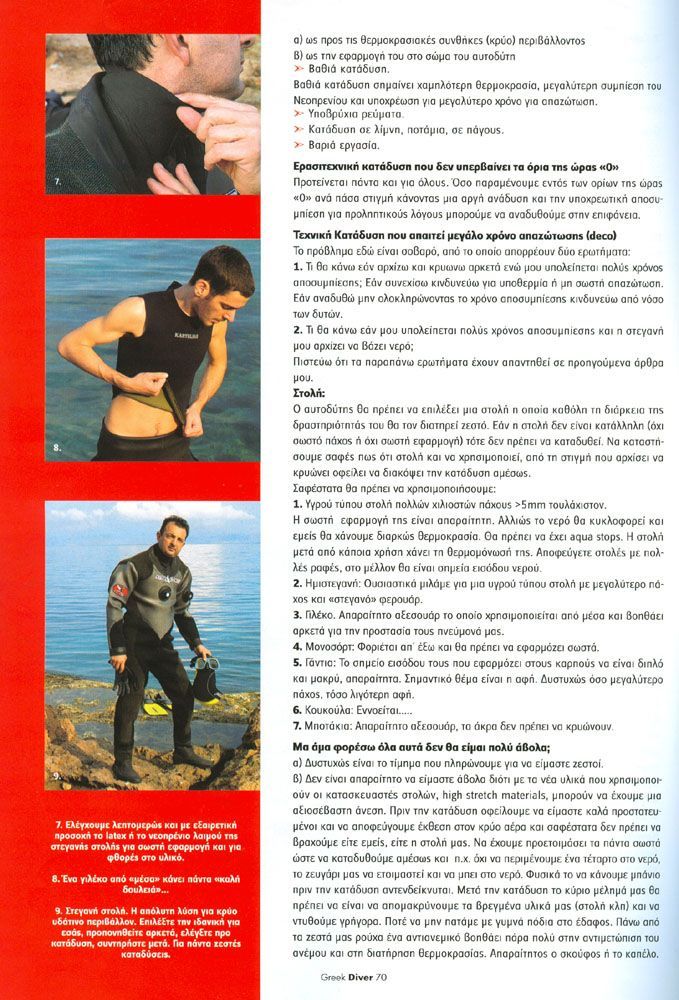
Ο αυτοδύτης θα πρέπει να επιλέξει μια στολή η οποία καθ' όλην την διάρκεια της δραστηριότητάς του θα τον διατηρεί ζεστό. Εάν η στολή δεν είναι κατάλληλη (όχι σωστό πάχος ή όχι σωστή εφαρμογή) τότε δεν πρέπει να καταδυθεί. Να καταστήσουμε σαφές ότι, ότι στολή και να χρησιμοποιεί από την στιγμή που έχει αρχίσει να κρυώνει οφείλει να διακόψει την κατάδυση αμεσως.
Σαφέστατα θα πρέπει να χρησιμοποιήσουμε:
1. Υγρού τύπου στολή πολλών χιλιοστών πάχους >5mm τουλάχιστον
Η σωστή εφαρμογή της είναι απαραίτητη. Αλλιώς το νερό θα κυκλοφορεί και εμείς θα χάνουμε διαρκώς θερμοκρασία. Θα πρέπει να έχει aqua stops.Η στολή μετά από κάποια χρήση χάνει την θερμομόνωση της. Αποφεύγετε στολές με πολλές ραφές, στο μέλλον θα είναι σημεία εισόδου νερού.
2. Ημιστεγανή Ουσιαστικά μιλάμε για μια υγρού τύπου στολή με μεγαλύτερο πάχος και στεγανό φερμουάρ.
3. Γιλέκο. Απαραίτητο αξεσουάρ το οποίο χρησιμοποιείται από μέσα και βοηθάει αρκετά για την προστασία τους πνεύμονα μας.
4. Μονοσόρτ. Φοριέται απ' έξω και θα πρέπει να εφαρμόζει σωστά.
5. Γάντια. Το σημείο εισόδου τους που εφαρμόζει στους καρπούς να είναι διπλό και μακρύ. Απαραίτητα. Σημαντικό θέμα είναι η αφή. Δυστυχώς όσο μεγαλύτερο πάχος τόσο λιγότερη αφή.
6. Κουκούλα. Εννοείται...
7. Μποτάκια. Απαραίτητο αξεσουάρ. Τα άκρα δεν πρέπει να κρυώνουν.
But if I wear all this, won't I be very uncomfortable?
α) Δυστυχώς είναι το τίμημα που πληρώνουμε για να είμαστε ζεστοί.
β) Δεν είναι απαραίτητο να είμαστε άβολα διότι με τα νέα υλικά που χρησιμοποιούν οι κατασκευαστές στολών, high stretch materials, μπορούν να έχουμε μια αξιοσέβαστη άνεση.
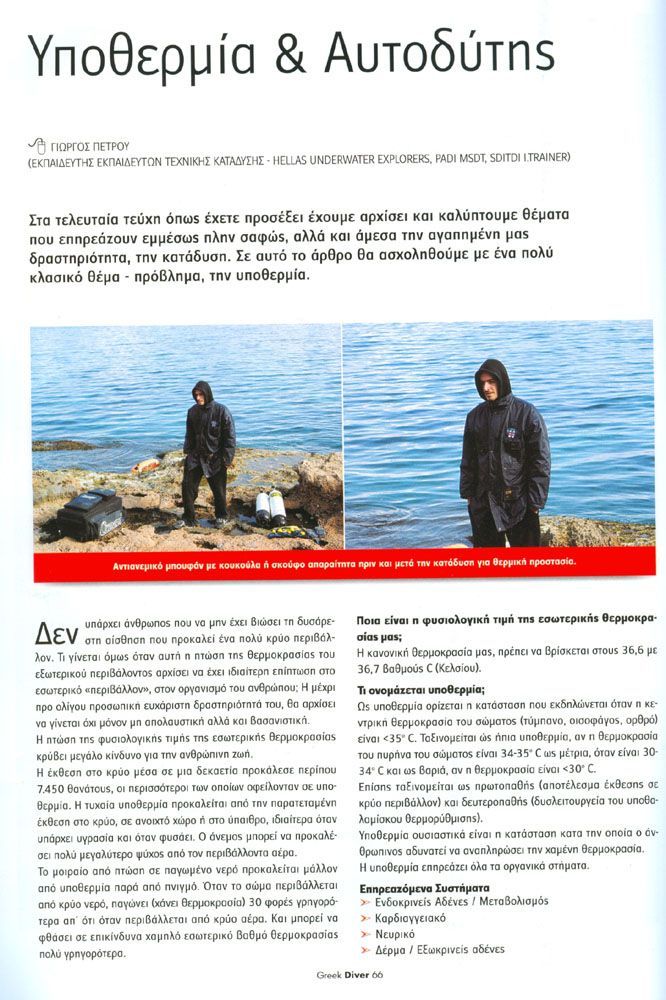
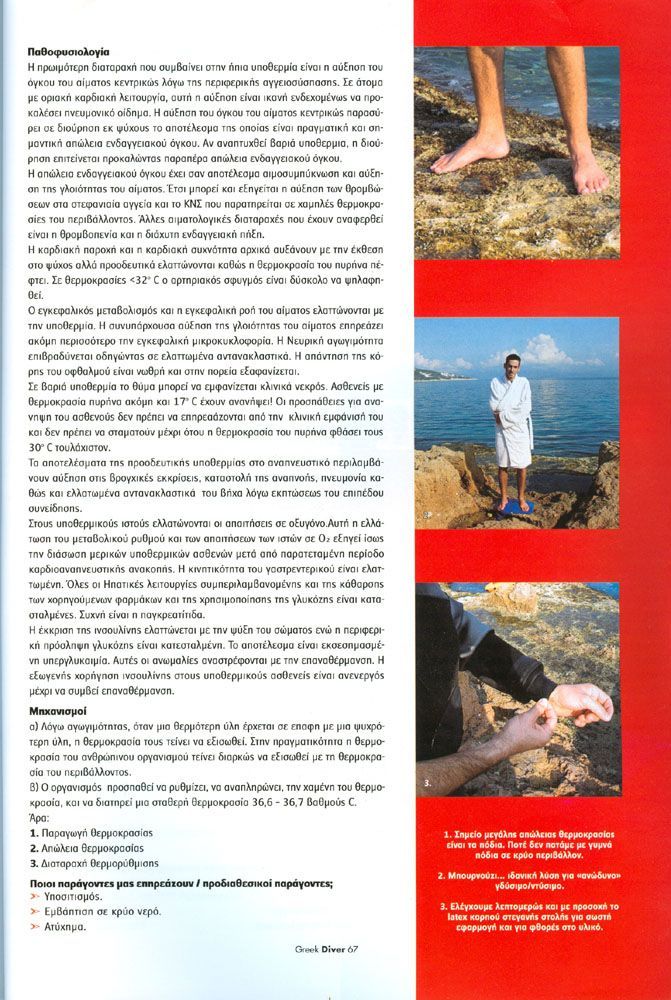
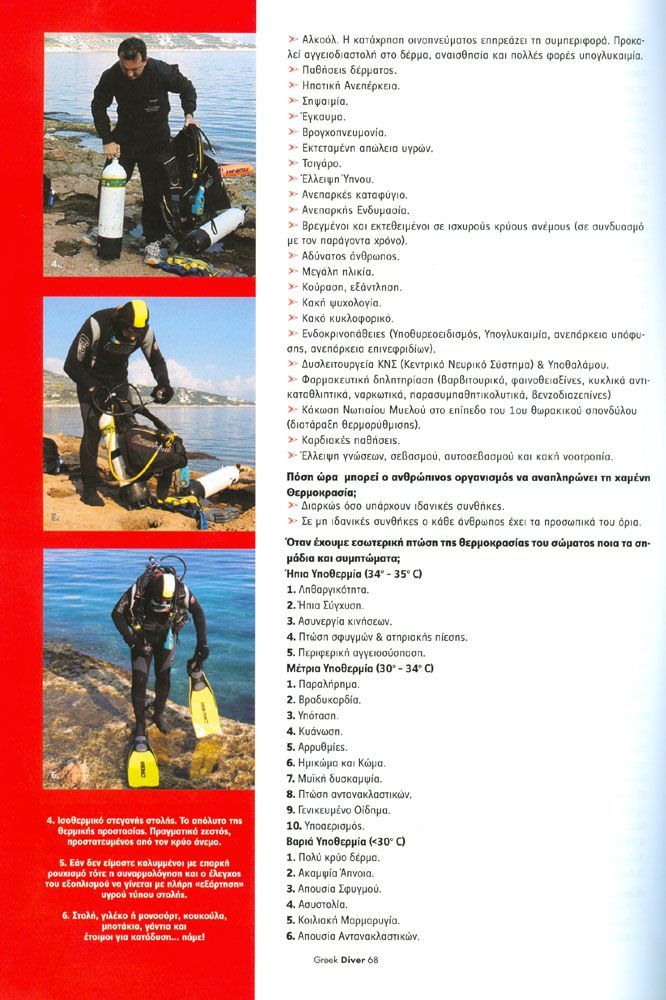
Before diving, we must be well protected and avoid exposure to cold air and clearly neither we nor our suit should get wet. We must have prepared everything properly so that we can dive immediately and, for example... not wait a quarter of an hour in the water for our partner to get ready and enter the water. Of course, bathing before diving is contraindicated. After diving, our main concern should be to remove our wet materials (suit, etc.) and get dressed quickly. Never step barefoot on the ground. Over our warm clothes, a windbreaker helps a lot in dealing with the wind and maintaining temperature. A cap or hat is essential.
8. Drysuit / Thermal
Here we have to choose from various materials such as Trilaminate or Neoprene. The first does not provide thermal protection as a material while the second does. Both, however, rely on the existence of air inside them for thermal insulation. The use of Argon is recommended for greater thermal protection. We never fill the dry suit with a mixture containing helium. The isothermal should be warm, breathable and have a material that allows water to slide over it.
Before diving, it is advisable not to wear the wetsuit for too long because it is not good to sweat. We should have checked its correct application on the wrists and neck. After diving, we simply get dressed and of course do not expose ourselves to the cold.
Σαφέστατα η στεγανή στολή μας διατηρεί πιο ζεστούς αλλά πάντα υπάρχει η περίπτωση να πάρει νερό. Το πόσο νερό, με τί ρυθμό μπαίνει είναι ένα κρίσιμο θέμα σε σχέσει με τον υπολειπόμενο αναγκαστικό χρόνο παραμονής στο βυθό...
Η υγρού τύπου στολή μας προειδοποιεί αρκετά πριν φθάσουμε σε κάποιο ανησυχητικό σημείο.
Αντιμετώπιση:
Stop further temperature loss (dive stop) Ascent to the surface, observing all rules, safety measures, rhythms, tables, decompression stops, etc. We take off wet clothes, put on dry and warm clothes. We protect ourselves from cold winds. Support with proper nutrition hot drinks, soup, chocolate, carbohydrates, pasta, sugars, honey, nuts, foods with high calorie content. No alcoholic beverages because they dilate the skin vessels and allow warm blood to go to the skin, while cold blood to enter the interior of the body, to the vital organs. Resulting in a drop in temperature and other things with perhaps dramatic results. Transfer to a medical center Rewarm gradually and not quickly. Rest. Psychological support
Constant contact to record signs and symptoms.
3. The use of Helium in the drysuit, for long dives & deco, during decompression
4. Hypothermia and anesthesia
5.Υποθερμία πως λειτουργεί το 100 Ο2?
5.Liquid O2
A big thank you to the Doctor and collaborator of Hellas Underwater Explorers Dr. Triantafyllou Stergios for his valuable help.
Bibliography
Medic First Aid Manual SDI
Emergency Care Reference Manual PADI
Br.J.Anaesth.1997 Aug/79(2):214-25
N.Eng.J.Med.1997 Nov 20 /337 (1):1545-1547
JAMA: 1998 Jan 14 / 279 (2): 102
AACN-Clin-Issues 1997 Aug / 8 (3): 368-382
Περιβαντολογικές Επείγουσες καταστάσεις / κεφ 368 (IV-709,710,711,712)
Ιατρική Βιβλιοθήκη Πανεπιστημίου Αθηνών
Αρχείο Hellas Underwater Explorers
Publications
Share this