


Some useful information about Decompression
Άρθρο: Γιώργος Πέτρου
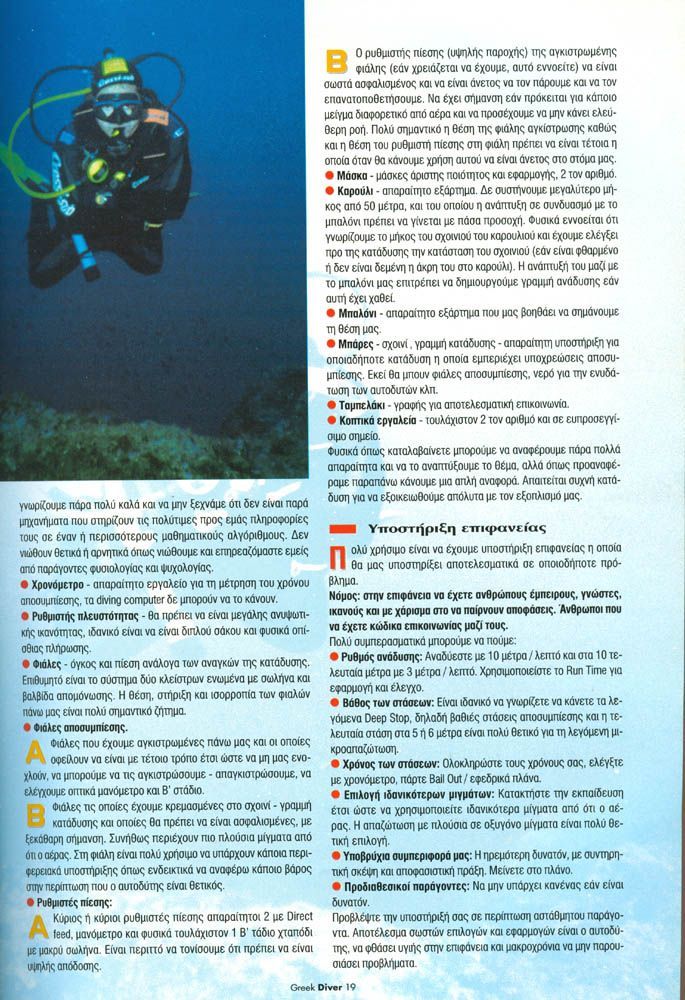
Φώτο: Αρχείο Greek Diver
This article is exactly what its title says. I would also add the words "basic and important information".
Compression and Decompression are done by nature with the Pressure Difference (PPgas of environment vs PPtissues) but our own behavior and choices will influence our physiology as to which direction it will take:
- health
- παθογένειας.
Με απλά λόγια μιλάμε για θέματα όπως Ρυθμό κατάδυσης / ανάδυσης, βάθος / χρόνος κατάδυσης, χρόνοι / βάθη / μείγματα, συνθήκες περιβάλλοντος, φυσιολογίας μας αποσυμπίεσης και πολλά άλλα...
"The following information in this article can of course in no way be considered sufficient information or play the role of a complete Decompression manual. The purpose of this article is to present a set of useful information that will either remind us of knowledge or expand our knowledge."
Due to the ideal conditions of the season we sometimes dive deeper, stay longer or do a combination of the two.
Given the effect of Henry's law on the solubility of gases (and specifically the dissolution of nitrogen), we shoulder a series of obligations during ascent which are none other than those we call Decompression.
But let's remember in simple words what decompression means?
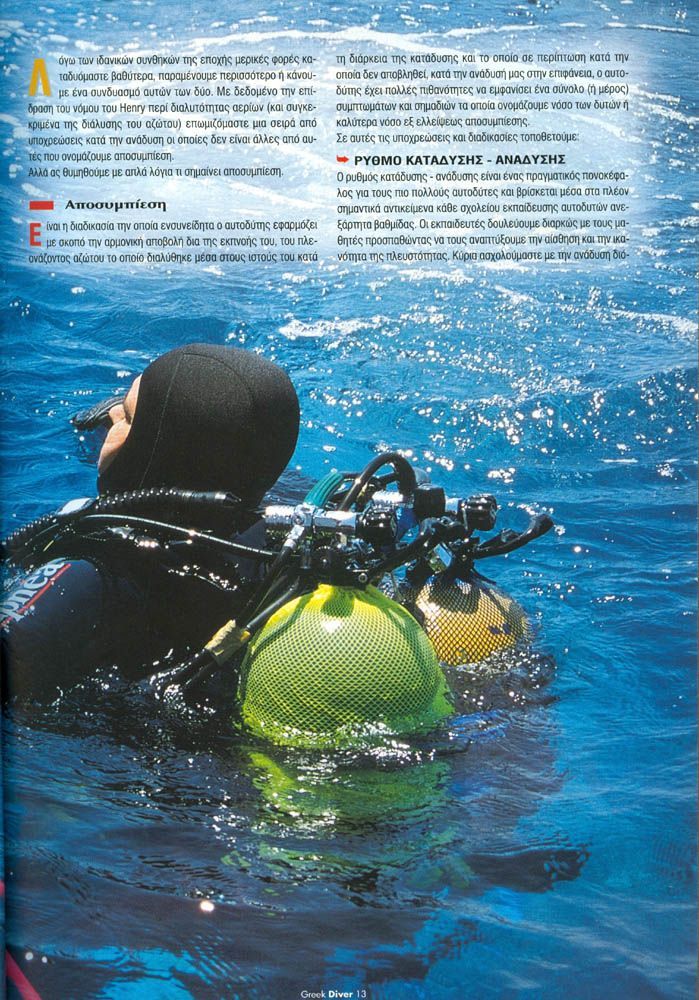
Decompression
is the process that the scuba diver consciously applies with the aim of harmoniously expelling, through his exhalation, the excess Nitrogen that was dissolved in his tissues during the dive and which, in the event that it is not expelled, upon surfacing, the scuba diver has a high probability of displaying a set (or part) of symptoms & signs that we call Diver's Illness or better, Decompression Sickness.
In these obligations and procedures we place:
1. ΡΥΘΜO ΚΑΤΑΔΥΣΗΣ / ΑΝΑΔΥΣΗΣ
Ο ρυθμός Κατάδυσης / ανάδυσης είναι ένας πραγματικός πονοκέφαλος για τους πιο πολλούς αυτοδύτες, και ευρίσκεται μέσα στα πλέον σημαντικά - αντικείμενα κάθε σχολείου εκπαίδευσης αυτοδυτών ανεξάρτητα βαθμίδος. Οι εκπαιδευτές δουλεύουμε διαρκώς με τους μαθητές προσπαθώντας να τους αναπτύξουμε την αίσθηση και την ικανότητα της πλευστότητας. Κύρια ασχολούμαστε με την ανάδυση διότι αυτή εμπλέκεται με την αποσυμπίεση. Ένας σωστός αυτοδύτης οφείλει να ελέγχει απόλυτα την υποβρύχια συμπεριφορά του. Τρόπος επίτευξης φυσικά η διαρκής εξάσκηση / επανάληψη σε κάθε κατάδυσή μας.
It is a matter of:
• Comfort
• Aquatic life
• Enjoyment
• Beautiful image
• Security
Safety because this diver will be able to implement a correct plan. A plan that includes the correct rate/time of dive/ascent as well as decompression stops.
Let's take an example:
Κάνουμε μια κατάδυση στα 30 μέτρα για 30 λεπτά . Σύμφωνα με τον Buhlmann Air Sea level (0-700 m) οφείλουμε να κάνουμε αποσυμπίεση στα 6 μέτρα για 2 λεπτά και στα 3 μέτρα για 7 λεπτά.
This decompression is only valid if we stick to the descent and stay plan.
Now, if we look at the expansion of a bubble, during the ascent we will notice that from the last 10 meters to the surface it presents a 100% increase in its volume. This pretentiously simplistic observation combined with the collection of scientific data on physiology, bubble mechanics, etc. has led us to the following data which we must apply during our ascent:
• Ανάδυση με μέγιστη ταχύτητα 10 μέτρα ανά λεπτό από βαθιά (40 μ. και άνω) έως τα 10 μέτρα βάθος.
• Ascent at a maximum speed of 3 meters per minute from 10 meters depth to the surface. For a decompression plan to be valid, we must accurately apply the dive/ascent rate, dwell time.
2. DEPTH OF STOPS / TIME OF STOPS / BUOYANCY
Ο αυτοδύτης οφείλει να είναι ικανότατος στο θέμα της πλευστότητα ς αλλιώς να μην κάνει καμία απόπειρα να καταδυθεί δημιουργώντας υποχρεώσεις αποσυμπίεσης. Υποχρεώσεις στις οποίες δεν θα τα βγάλει πέρα.
Όταν λέμε στάση στα 6 μέτρα, εννοούμε στα 6 μέτρα και όχι 5 ή 7 μέτρα. Τελεία και παύλα.
Πολύ σημαντικό είναι να καταλάβουμε πως οποιοδήποτε μοντέλο αποσυμπίεσης και εάν χρησιμοποιήσουμε, οφείλουμε να το εμπιστευτούμε και να το εφαρμόσουμε χωρίς αλλαγές, και τέτοια βασικά μοντέλα αποσυμπίεσης είναι τα εξής:
"Decompression Model"
• Bulk Diffusion Model
• Multitissue Model
• Thermodynamic Model
• Reduced Gradient Bubble Model
• Tissue Bubble Diffusion Model
" Μ έ σ ο π λ η ρ ο φ ό ρ η σ ή ς μ α ς "
• Decompression Table
• Diving Computer
• Dive Planning Software
Η κατάδυση σε ακραία όρια ή η επέκταση των ορίων απαιτεί:
• Very good planning and programming
Η κατάδυση σε ακραία όρια ή η επέκταση των ορίων μας θέτει:
• At risk from unpredictable factors
To better understand this, I give two examples.
1st Consider a scuba diver who is required to do 40 minutes of decompression and at 15 minutes begins to get cold and feels that he is very soon going to be in the dangerous phase of Hypothermia, what will he do? Will he remain experiencing hypothermia, risking illness from it, or will he interrupt his Decompression, emerge to the surface where he will breathe pure oxygen and go to the chamber?
2ον Σκεφτείτε να τα έχει υπολογίσει όλα ώστε να υπάρχει επάρκεια αερίου για εσάς, όταν ξαφνικά έρχεται το ζευγάρι σας το οποίο απαιτεί / ζητάει από εσάς πλήρη κάλυψη των απαιτούμενων για αυτόν αερίων, διότι για κάποιο λόγο έχει βρεθεί εκτός προγραμματισμού. Ετοιμάζεστε να τον υποστηρίξετε όταν συνειδητοποιείτε ότι το πιθανότερο είναι να μην ολοκληρώσετε εσείς την διαδικασία της αποσυμπίεσής σας. Τι θα κάνετε?
Depth of stops:
Ακριβώς στο βάθος που λέει το μέσο πληροφόρησης που έχουμε επιλέξει. Καμία αλλαγή.
Επίσης είναι ιδανικό να γνωρίζετε να κάνετε τα λεγόμενα Deep Stop, δηλαδή Βαθιές στάσεις Αποσυμπίεσης.
Η τελευταία στάση στα 5 ή 6 μέτρα είναι πολύ θετικό για την λεγόμενη Μικρο-Αγγειακή Απαζώτοση.
Don't skip decompression stops.
Time of stops:
Complete your times, check with a stopwatch, take Bail Out/Backup shots etc. Do not reduce decompression times.
3. ΕΠΙΛΟΓΗ ΙΔΑΝΙΚΟΤΕΡΩΝ ΜΙΓΜΑΤΩΝ ΓΙΑ ΚΑΤΑΔΥΣΗ ΚΑΙ ΕΝ ΣΥΝΕΧΕΙΑ ΑΠΟΣΥΜΠΙΕΣΗ
Although much has been written on this topic, we will indicatively mention that our choices are:
• Air
• Enriched Air Nitrox
And...
• Trimix? NO... Caution: Trimix is not for Decompression
It is clear that choosing the appropriate mixture has to do with our level of training and the elements of the dive: depth and time spent.
• Up to a depth of 30-40 meters, air is ideal for diving. We can also use air itself as decompression, but the most preferable solution for optimizing our denitrification is Enriched air Nitrox.
• A very good choice of mixture for diving up to 30-40 meters is Enriched air Nitrox with the same or a richer decompression mixture.
• For dives below 40 meters, many people prefer air. In principle, none of us should dive deeper than 30-40 meters. Personally, for clarity reasons, I prefer to dive very rarely with air and more often with a Trimix mixture and decompression with Enriched Air Nitrox.
Important factors that we must pay attention to, calculate, and control are:
• Nitrogen Narcosis
• CNS Poisoning
• Pulmonary Toxicity
For our best Denitrification, the choice and use of Enriched Air Nitrox is definitely recommended.
4. our underwater behavior which will substantially affect our physiology, psychology and in general not only the completion of the time but mainly the completion of a Qualitative decompression and we must not have PREDISPOSITIVE - AGGRESSIVE FACTORS
Effect of Aggravating factors such as:
• Συσσώρευση CO2 = αυξάνει την ροή όλων των αερίων υπό διάλυση προς τους ιστούς του σώματος.
Λόγοι οι οποίοι συμβάλουν σε αυτό είναι
a) Increased physical activity (work production) before diving, during diving, during decompression, after diving b) "hard pressure regulator" c) breath holding
• Hypothermia, which can reduce the rate at which gases already in the tissues are returned to the lungs and can slow the return/excretion of Nitrogen
• Hyperthermia, especially in the summer, is a very insidious and dangerous condition. It increases the flow of all dissolved gases to the body's tissues.
• Dehydration. It is very important to drink plenty of water before and after. Start hydrating systematically 24-48 hours before diving. A diver who is dehydrated is at risk of getting sick since dehydration reduces the amount of available blood, causes hemoconcentration, for gas exchange, slowing down the removal of Nitrogen from the body. Avoid diuretics - drinks such as coffee, tea, chocolates, colas, etc. I consider the habit of many divers to drink underwater to be very positively supportive.
• Πρόσφατες ορθοπεδικές κακώσεις ή τραύματα
• Obesity
• Alcohol
• Old age, etc.
Many times we need to think quite simply, such as the case where two scuba divers do exactly the same dive profile, but one consumes 180 bar from his 18 liter tank while the other consumes 120 bar from his 15 liter tank. Will they both do the same Denitrification process?
However, we often find that many scuba divers do not have a serious understanding and proper approach to these obligations.
Decompression is a very serious process and should be distinguished from:
• preparation / support & prevention / response planning
• adequacy and quality of equipment
• application accuracy
• ideal conditions
Within the limits of Time "O"
I keep hearing a lot of people say that when I dive at the “O” hour limits I don’t need a decompression stop. I don’t need to deoxygenate. Hmm…that’s not right.
Denitrification is required after each dive. AND within the limits of the O time. We do denitrification by surfacing correctly. Our ascent is our Denitrification.
I would say that we always (MANDATORY), should do a decompression stop for preventive reasons. Such reasons (some) are:
Η διαφορά στα όρια της ώρας "0" που παρουσιάζουν μεταξύ τους οι πίνακες. Για παράδειγμα :
*Ο πίνακας Buhlmann/Hahn (0-250μ) μας δίνει ώρα 0 στα 30 μέτρα 17 λεπτά
*Ο πίνακας PADI μας δίνει ώρα 0 στα 30 μέτρα 20 λεπτά
*Ο Γαλλικό πίνακας της Aqualung μας δίνει ώρα 0 στα 30 μέτρα 10 λεπτά
*Ο SSDF πίνακας μας δίνει ώρα 0 στα 30 μέτρα 20 λεπτά
*Ο YMCA μας δίνει ώρα 0 στα 30 μέτρα 20 λεπτά
*O κλασικός U.N. Navy μας έδινε ώρα 0 στα 30 μέτρα 25 λεπτά
*Νεότερος Buhlmann ( 0-700μ) μας δίνει ώρα 0 στα 30 μέτρα 9 λεπτά
και με υποχρέωση στάσης στα 3 μέτρα.
If we take into account the difference presented by the last two tables, we understand how vulnerable we are. Clearly, we must be informed about the most recent tables in terms of publication and information and follow them because they are safer:
• διότι διαθέτουν την νεότερη εξέλιξη γνώσης και στατιστικής περί της ώρας 0
• because they have the latest knowledge on proper decompression methodology (stops = depth / time).
NECESSARY DECOMPRESSION = CEILING
Of course, there are many other tables that are worth using and trusting. Personally, I use:
• The Abyss Software tables
• Αλγόριθμους του dive computer Vytec Suunto
• Newer Buhlmann
• And I use DCIEM very often.
Every dive that results in Decompression obligations means that a virtual but at the same time real ceiling has automatically been created above us. A mandatory binding limit = invisible ceiling = depth, at which we must complete a certain time before:
• we go to the next decompression stop (depth), for a specific time stay
• or we emerge to the surface
Σαν καταδύσεις οροφής ο περισσότερος αριθμός αυτοδυτών θεωρεί σωστά την Ναυαγιοδιείσδυση, Σπηλαιοκατάδυση αλλά θα πρέπει σαφέστατα να προσθέσει σε αυτή την λίστα και την κατάδυση η οποία δημιουργεί υποχρεώσεις αποσυμπίεσης. Το βάθος / στάση αποσυμπίεσης δεν είναι παρά μια οροφή. Τέτοια κατάδυση όπως περιγράψαμε και παραπάνω είναι:
• either deep diving
• either diving with a long dwell time
• or a combination of the two above
RECOMPRESSION
Too many times I am asked to answer whether it is right for a scuba diver who has surfaced (whether or not they have shown symptoms) without completing, or not doing any decompression at all, when they should have done so, and often with a combination of explosive ascents, to re-enter the water for recompression.
This is a serious question that can only be answered in a technical diving training school, to be analyzed comprehensively, thoroughly, to have a clear picture. Of course, there are recompression methodologies, but the person who will decide, the conditions that must be properly assessed and the methodology that will be followed is a very delicate and complicated process, in which it is good for Hyperbaric Medicine Doctors to be involved and take responsibility. The responsibility is great.
Surface Decompression
I take it for granted that we all know that the final phase of completing our Denitrification takes place on the surface. Therefore, our behavior on the surface must be very careful, meaning no fatigue, no production of work, and the rest.
GAS AMOUNT
We will have to decide and take care when planning the dive whether, in addition to the gases necessary for us, we will also include an amount of gas that will cover the worst case scenario of our partner running out of air. Of course, my partner will have to do the same for us.
But suddenly:
• we are loaded with a lot of equipment
• μήπως προσθέτουμε στοιχεία πολυπλοκότητας στην κατάδυσή μας?
We should not add anything to ourselves that will create problems for us. It is safe and right for each of the couple to have taken care of all emergencies for themselves and not to rely on the other.
Calculate the unweighted factor.
ΕΞΟΠΛΙΣΜΟΣ ΑΠΟΣΥΜΠΙΕΣΗΣ
Σε μια κατάδυση σαν αυτή την οποία χρειαζόμαστε αποσυμπίεση απαιτείται πολύ μεγάλη προσοχή στο θέμα του εξοπλισμού. Τα στοιχεία που θα πρέπει να υπάρχουν είναι:
• Επάρκεια εξοπλισμού
Προσοχή: δεν κάνουμε τη κατάδυση με ότι εξοπλισμό έχουμε αλλά κάνουμε την κατάδυση με ότι εξοπλισμό απαιτείται.
• Ποιότητα εξοπλισμού
Προσοχή: Πέραν του κυρίου εξοπλισμού μας, επιβάλλεται και ο υποστηρικτικός εξοπλισμός να είναι υψηλής απόδοσης. Δεν επιτρέπεται το Β΄ Στάδιο του χταποδιού να μην είναι εξίσου υψηλής απόδοσης όπως και το κύριο Β΄ στάδιο.
• Equipment redundancy Because the unpredictable or otherwise unpredictable factor can "strike" at any time and some piece of equipment may present a partial or total malfunction, we must create conditions so that we have an alternative solution if possible for every case.
Let's make a small but basic comment on a few pieces of equipment:
• Suit - it needs to be several millimeters thick or a dry suit. Under no circumstances should we get cold or experience hypothermia. Filling the dry suit with Argon is a proper supportive solution and support.
• Diving Computer - Σαφέστατα και απαιτείται, και μάλιστα προτείνεται να έχουμε 2. Ένα κύριο και ένα εφεδρικό. Οφείλουμε να τα γνωρίζουμε πάρα πολύ καλά και να μην ξεχνάμε ότι δεν είναι παρά μηχανήματα που στηρίζουν τις πολύτιμες προς εμάς πληροφορίες τους σε έναν ή περισσότερους μαθηματικούς αλγόριθμους. Δεν νιώθουν θετικά ή αρνητικά όπως νιώθουμε και επηρεαζόμαστε εμείς από παράγοντες φυσιολογίας & ψυχολογίας.
• Χρονόμετρο - απαραίτητο εργαλείο για την μέτρηση του χρόνου αποσυμπίεσης, τα diving computer δεν μπορούν να το κάνουν.
• Ρυθμιστής Πλευστότητας θα πρέπει να είναι μεγάλης ανυψωτικής ικανότητος, ιδανικό είναι να είναι διπλού σάκου και φυσικά οπίσθιας πλήρωσης.
• Φιάλες - Όγκος και πίεση ανάλογα των αναγκών της κατάδυσης. Επιθυμητό είναι το σύστημα δύο κλείστρων ενωμένα με σωλήνα και βαλβίδα απομόνωσης. Η θέση, στήριξη και ισορροπία των φιαλών πάνω μας είναι πολύ σημαντικό ζήτημα.
• Decompression tanks. A) Tanks that we have hooked on us and which must be in such a way that they do not bother us, that we can hook them - unhook them, visually check the pressure gauge and second stage. B) Tanks that we have hanging on the rope - diving line and which must be secured, with clear markings. They usually contain richer mixtures than air. It is very useful to have some peripheral support in the tank, such as, for example, some weight in the case that the diver is positive.
• Ρυθμιστές πίεσης
Α) Κύριος ή κύριοι ρυθμιστές πίεσης απαραίτητοι 2 , με Direct feed, μανόμετρο, και φυσικά τουλάχιστον 1 Β΄στάδιο χταπόδι με μακρύ σωλήνα. Είναι περιττό να τονίσουμε ότι πρέπει να είναι υψηλής απόδοσης.
Β) Ο Ρυθμιστής πίεσης (υψηλής παροχής) της αγκιστρωμένης φιάλης (εάν χρειάζεται να έχουμε-αυτό εννοείτε) να είναι σωστά ασφαλισμένος και να είναι άνετος να τον πάρουμε και να τον επανατοποθετήσουμε. Να έχει σήμανση εάν πρόκειται για κάποιο μείγμα διαφορετικό από αέρα και να προσέχουμε να μην κάνει ελεύθερη ροή. Πολύ σημαντικό η θέση της φιάλης αγκίστρωσης καθώς και η θέση του ρυθμιστή πίεσης στη φιάλη πρέπει να είναι τέτοια ή οποία όταν θα κάνουμε χρήση αυτού να είναι άνετος στο στόμα μας.
• Mask - Masks of excellent quality and fit, 2 in number.
• Reel - essential accessory. We do not recommend a length greater than 50 meters, and its deployment in combination with the balloon must be done with great care. Of course, it is understood that we know the length of the reel rope and have checked the condition of the rope before diving (if it is worn or its end is not tied to the reel). Its deployment together with the balloon allows us to create an ascent line if it has been lost.
• Balloon - an essential accessory that helps us mark our position.
• Bars- Rope / Diving Line- essential support for any dive that involves decompression obligations. This will hold decompression tanks, water for the hydration of scuba divers, etc.
• Writing pad for effective communication
• Cutting tools - at least 2 in number and in an easily accessible place.
Of course, as you can see, we can mention many essentials and develop the topic, but as we mentioned above, we will make a simple reference. Frequent diving is required to become completely familiar with our equipment.
SURFACE SUPPORT
It is very useful to have surface support that will effectively support us in any problem. Law: on the surface, have people who are experienced, knowledgeable, capable and gifted in making decisions. People with whom you have a communication code.
Very conclusively we can say:
1. Ρυθμός ανάδυσης:
Αναδύεστε με 10 μέτρα / λεπτό και στα 10 τελευταία μέτρα με 3 μέτρα / λεπτό
Χρησιμοποιείστε το Run Time για εφαρμογή και έλεγχο.
2. Bάθος των στάσεων:
Είναι ιδανικό να γνωρίζετε να κάνετε τα λεγόμενα Deep Stop, δηλαδή Βαθιές στάσεις Αποσυμπίεσης και η τελευταία στάση στα 5 ή 6 μέτρα είναι πολύ θετικό για την λεγόμενη Μικρο-Απαζώτοση.
3. Xρόνος των στάσεων:
Ολοκληρώστε τους χρόνους σας , ελέγξτε με χρονόμετρο, πάρτε Bail Out / Εφεδρικά πλάνα.
4. Eπιλογή ιδανικότερων μειγμάτων:
Κατακτήστε την εκπαίδευση έτσι ώστε να χρησιμοποιείτε ιδανικότερα μίγματα από ότι ο αέρας. Η Απαζώτοση με πλούσια σε Οξυγόνο μίγματα είναι πολύ θετική επιλογή.
5. Yποβρύχια συμπεριφορά μας:
Η ηρεμότερη δυνατόν, με συντηρητική σκέψη και αποφασιστική πράξη. Μείνετε στο πλάνο.
6. Προδιαθεσικοί παράγοντες:
Να μην υπάρχει κανένας εάν είναι δυνατόν.
Προβλέψτε την υποστήριξή σας σε περίπτωση αστάθμητου παράγοντα.
The result of correct choices and applications is the scuba diver:
• να φθάσει υγιής στην επιφάνεια
• not to present problems in the long term
Publications
Share this