


Article: George PetrouPhotos: Greek Diver
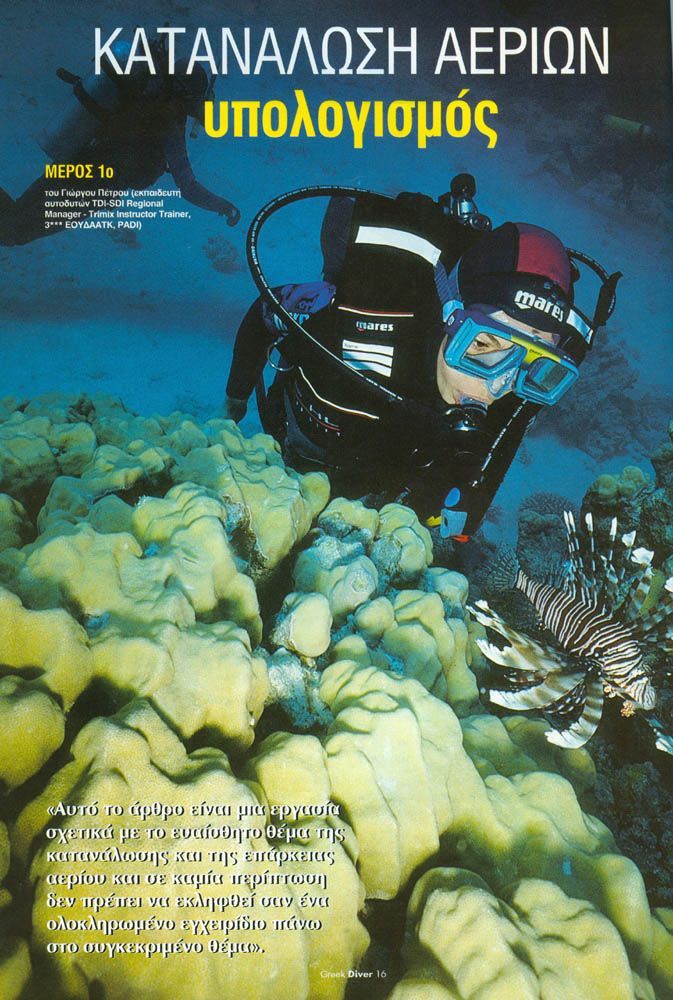
Gas Consumption - Calculation
Aυτό το άρθρο είναι μια εργασία σχετικά με το ευαίσθητο θέμα της κατανάλωσης και της επάρκειας αερίου και σε καμία περίπτωση δεν πρέπει να εκληφθεί σαν ένα ολοκληρωμένο εγχειρίδιο πάνω στο συγκεκριμένο θέμα. Ο Υπολογισμός Κατανάλωσης αερίων αφορά όλους, ερασιτέχνες, τεχνικούς αυτοδύτες και επαγγελματίες δύτες και είναι μια διαδικασία απόλυτα συνυφασμένη με την ασφάλειά μας, την δυνατότητα να σχεδιάζουμε την κατάδυσή μας, την δυνατότητά μας να ελέγχουμε ανά πάσα στιγμή την κατάδυσή μας και όλα αυτά με λεπτομέρεια διότι θα πρέπει να αποφύγουμε να βιώσουμε την δυσάρεστη κατάσταση έλλειψης αερίου.
Gas Consumption Calculation concerns everyone, amateurs, technical scuba divers and professional divers and is a process completely intertwined with
• Our safety
• The ability to plan our dive
• Our ability to control our dive at any time...and all this in detail...because we must avoid experiencing the unpleasant situation of gas shortage.
Amateur diving means the simplest form of underwater swimming up to a depth of 30 meters (defined by Greek law) while remaining within the diving time of "0" hours. During this time, conditions must be absolutely ideal and controlled. Work production must be as minimal as possible and we should not get involved in extreme situations.
Technical Diving is a term that was essentially established in 1992 by the magazine "Aqua Corps" with the aim of defining the organized activity of a (small then, but very large and constantly growing today) number of scuba divers in a set of special forms of diving such as:
• Βαθιά κατάδυση
• Nocturnal
• Cave diving
• Wreck diving
• Decompression Diving
• Mixed gas diving ...and many others...
Gases
When we discuss gases or mixtures, many people misunderstand them as some unknown, complex, or dangerous subject. In anything new that we wish to engage with and use, whether it is gases or equipment, training in it is an essential safety factor.
Let's see what gases we can breathe while diving:
• Air: air is the most common gas mixture which consists of two gases. Oxygen O2 & Nitrogen N2. And because it consists of these two gases it is also called Nitrox 21!!! I am sure that for many of you the concept that our air is a mixture and is called Nitrox 21 will seem incredible. But that is how it is. Our air is generally composed of 21% O2 and 79% N2. Nitrogen & Oxygen = Nitrox.
• EANx (Enriched Air Nitrox):
είναι ουσιαστικά αυτό το οποίο πολύς κόσμος συζητάει σαν Nitrox. Το ΕΑΝx είναι ένα μίγμα το οποίο αποτελείται από τα δύο αέρια από τα οποία αποτελείται και ο αέρας μας, δηλαδή Ο2 και Ν2 αλλά με την διαφορά ότι το ποσοστό Ο2 είναι μεγαλύτερο από 21% , όπως π.χ. 28%, 32%,36%,60%,80% και ούτω καθ΄ εξής. Άρα ένα ΕΑΝ 32 σημαίνει Ο2 32% και Ν2 68%. Κύρια το χρησιμοποιούμε για μεγαλύτερη ώρα Ο, λιγότερη Απορρόφηση Αζώτου και καλύτερη Απαζώτοση.
• Trimix: one of the most useful and least common gas mixtures. Trimix is a mixture consisting of 3 gases such as Oxygen, Nitrogen, Helium and its use is to reduce (control) Oxygen Toxicity, Nitrogen Narcosis in deep diving. Extremely ideal and safe but requires a high level of training, design, equipment, support and performance.
There are other mixtures, such as Heliox, Neox, but we are not interested in them as their use is very specialized.
Choosing the right gas
Σε κάθε κατάδυσή μας πρώτα από όλα επιλέγουμε το μίγμα (ή μίγματα) το οποίο θα χρησιμοποιήσουμε.
Ενδεικτικά αναφέρουμε μερικά βασικά στοιχεία για την επιλογή του σωστού μίγματος αερίου:
• the depth of the dive & the control of Nitrogen Narcosis and Oxygen Toxicity. We know that from the moment the PPN2 (Partial Pressure of Nitrogen) reaches 3.2 - 4 Atm. then the diver becomes a candidate to show signs and symptoms of Nitrogen Narcosis. Correspondingly from the moment the PP02 (Partial Pressure of Oxygen) reaches 1.4 - 1.6 Atm. then the diver becomes a candidate to show signs and symptoms of Oxygen Toxicity. Clearly for depths beyond amateur limits, Trimix is safer from the perspective of "Clarity" and control, limiting the above risks for deep dives. Within the limits of recreational diving, EANitrox and our air are ideal.
• the dwell time, the N2 charge and the limits of the "0" hour are also important elements, as they can vary depending on the mixture we use. For example, the "0" hour at 18 meters with air is 56 minutes according to the data in the tables of the widely used diving organizations SDI (Scuba Diving International = the section of TDI that specializes in amateur training), PADI, etc. If someone dives to 18 meters not with air but with EAN32 then the "0" hour is extended to 95 minutes, and if they dive with EAN36 then it is extended to 125 minutes. Clearly within the limits of amateur diving (up to 30 meters) the use of EANitrox is superior to the use of air.
• η χρέωση 02 (CNS, OTU) είναι ένας παράγοντας ο οποίος αρχίζει να μας απασχολεί από την στιγμή που καταδυόμαστε με EANitrox.
"Of course, there are many other factors and elements that influence the choice of a gas (or gases). The above are indicative..."
Επάρκεια Αερίου
This is the very important issue, and one that we will deal with below. Every time we go diving, an essential element of physical survival, psychological calm and coping with any incident is the adequacy of gas. For each dive depending on:
• the depth
• the year
• the conditions
• the activity
• the unweighted factors
• each individual person, their physical and psychological peculiarities require a very careful calculation before diving so that the diver has, even in the worst case, enough gas to allow him to surface. There are always the following simple questions: How much air do we need for this dive or is the air in my tank enough to make a specific dive? Below we will deal extensively with practical issues of calculating gas adequacy such as consumption rate, tank volume and pressure.
Given that we are trained and have the necessary knowledge, we should sit down with all the members who will participate in the dive directly and indirectly (surface support team) to: a) decide on the elements - limits of the dive b) select the correct gas(es) c) calculate the amount of gas and select the volume and pressure of the cylinders.
Let's create our own Consumption Table. What data do we need for this?
• SCR (Surface Consumption Rate) In order to be able to start any calculation, we must first know our personal breathing rate. That is, how many liters do we breathe per minute? A very important element that varies from scuba diver to scuba diver and which is influenced by many factors. But how can I know my personal breathing rate or SCR? The process is simple, I take my tank, go to a specific depth at which I move, swim normally and by recording some data, emerging to the surface, I know my SCR.
The data are as follows:
Tank volume we dived in X bars we consumed ------------------------------------------------------------------------------- = our SCR Absolute Depth Pressure X Dive Time
Let's do an example to make the process more specific and tangible.. I dive to a depth of 10 meters (so Absolute pressure 2 Atm.) with a 15 liter / 200 Bar tank. The time is 12:00. Just after 15 minutes of diving (so the time has passed 12:15) and remaining at the same depth I record the new pressure which is 160 bar. That is, diving to a depth of 10 meters with a 15 liter tank, I consumed 40 bar in 15 minutes.
I place my data in the formula:
15 liter tank X 40 bar we consumed 600 ----------------------------------------------------------------------------- = ----------------- = 20 liters per minute on the surface. 2 Atm. Absolute Depth Pressure X 15 minutes Dive Time 30
Now, knowing our SCR, i.e. the amount of gas at the surface in 1 Atmosphere, we can know how much we will consume per minute at greater depths.
Example: If our SCR, our consumption at 1 Atm. is 20 liters / minute and given that nothing will change in our rhythm, then at a depth of 30 meters we will breathe:
20 liters / minute X 4 Atm. (absolute pressure of 30 meters) = 80 liters / minute.
• Βάθος κατάδυσης
• Χρόνος κατάδυσης (παραμονής) & ώρα "0"
Εδώ οφείλουμε να υπενθυμίσουμε ότι ώρα "0" ονομάζουμε το μέγιστο επιτρεπόμενο χρόνο που μπορούμε να παραμείνουμε σε συγκεκριμένο βάθος χωρίς να χρειαστεί να μπούμε σε διαδικασίες Αποσυμπίεσης. Απαιτείται ταχύτητα Ανόδου 10μ / λεπτό και μια Υποχρεωτική στάση στα 5μέτρα ή 3 μέτρα για τρία λεπτά πριν την ανάδυσή μας στην επιφάνεια.
Τονίζουμε πως η διαδικασία Απαζώτοσης για μια κατάδυση στα όρια της ώρας "0" είναι ο σωστός ρυθμός κατά την ανάδυση + μια προληπτική στάση.
• Ρυθμός καθόδου
Ως είθισται έχει καθιερωθεί σε μέγιστο ρυθμό καθόδου ταχύτητα με 20μ / λεπτό. Μεγαλύτερος ρυθμός είναι αρνητικός για πολλούς και πλείστους λόγους. Σε βαθιές καταδύσεις η επιβράδυνση με συγκεκριμένη διαδικασία κατά την κατάδυση αποτελεί μια θετική επιλογή.
• Ascent Rate As we all know, the ascent rate directly affects our health and can be a determining factor in the occurrence or not of Divers' Illness. Ascent rates of 20m/min have long since disappeared. The modern view is that the Ascent rate should be 10m/min, and especially in the last 10 meters it should be 3m/min. In addition, the choice of deep decompression stops (Deep Stops) can only have a positive effect and results and is highly recommended.
• Decompression Time or Times The relationship between dive depth and dwell time determines the ascent and decompression data. During a dive, we may be within limits that require only a Mandatory Stop for Preventive Reasons. However, it may be necessary to make one or more decompression stops before surfacing. Very important factors here are the time and quality of decompression.
• Επιβαρυντικοί παράγοντες για αύξηση κατανάλωσης
Επιβαρυντικοί παράγοντες οι οποίοι θα επηρεάσουν την κατανάλωσή μας είναι η παραγωγή έργου και η αύξηση CO2 για πολλούς λόγους, η κακή ψυχολογία, η κακή πλευστότητα, κρύο κ.λπ.
• Modifiers - Safety Factors In order to be able to predict gas adequacy in the event that for any reason our consumption rate increases, we must include in our consumption table some factors, Safety Factors or Modifiers which are nothing more than a number which determines the size of the increase in our consumption rate depending on the size of the project production. These are: *Resting 1 One specifies a diving situation where the scuba diver performs a relaxing dive, a walk under more ideal conditions. *Mild 1.5 One and a half identifies a situation in which the diver is swimming at a low, mild effort *Moderate 2 Two identifies a situation in which the diver is swimming at a medium effort *Heavy 3 Three identifies a situation in which the diver is swimming at a heavy effort *Extreme Heavy 4 Four identifies a situation in which the diver is swimming at an extremely heavy effort
Let's give an example: A scuba diver has a breathing rate on the surface of 20 liters / minute. He dives to 20 meters deep where the conditions are ideal (so Modifier Resting = 1) and the amount of gas he will breathe is defined as follows 20 meters deep, so 3 Atm. X 20 liters / minute = 60 liters / minute However, if during his return the scuba diver e.g. due to a countercurrent produces a Moderate level work then the result is defined as follows 3 Atm X 20 liters / minute X Modifier 2 =120 liters / minute
• ADDD The acronym ADDD symbolizes safety limits that we must set in terms of design and practice in every dive.
* A Minimum Air Volume / Pressure - Minimum air pressure. * D Maximum Duration of Dive - Maximum dive time * D Maximum Depth of Dive - Maximum dive depth * D Maximum Distance of Penetration - Maximum distance
• A Minimum Air Volume / Pressure - Ελάχιστη πίεση αέρα.
Εδώ τίθενται δύο θέματα
α) Ρεζέρβα
Ρεζέρβα ονομάζουμε τον εφεδρικό μας αέρα τον οποίο δεν χρησιμοποιούμε ποτέ παρά μόνο σε περίπτωση ανάγκης και φυσικά εννοούμε την ποσότητα του αέρα που βγάζουμε στην επιφάνεια. Και επειδή η ένδειξη επάρκειας αερίου στα όργανά μας φαίνεται στο μανόμετρό μας αυτό μεταφράζεται σε ένδειξη Bar. Ας ορίσουμε την ρεζέρβα μας στα 50 bar αέρα που οφείλουμε να βγάλουμε στην επιφάνεια. Και εδώ μπαίνει το δεύτερο θέμα.
β) Ελάχιστη πίεση ανάδυσης. Σε ποία ελάχιστη πίεση αερίου (και σε ποια χρονική στιγμή) θα σταματήσω την κατάδυση / παραμονή και θα ξεκινήσω ανάδυση έτσι ώστε ο αέρας μου να είναι επαρκής για ανάδυση, Αποσυμπίεση και θα βγάλω στην επιφάνεια 50 bar Ρεζέρβα? Είναι καθαρά θέμα υπολογισμού κατανάλωσης αερίων.
* D Maximum Duration of Dive - Μέγιστος χρόνος κατάδυσης
Ο χρόνος της κατάδυσης μας πρέπει να έχει προσδιοριστεί και σε καμία περίπτωση δεν θα πρέπει να παραβιαστεί.
* D Maximum Depth of Dive - Μέγιστο βάθος κατάδυσης
Το βάθος της κατάδυσης μας πρέπει να έχει προσδιοριστεί και σε καμία
περίπτωση δεν θα πρέπει να παραβιαστεί.
* D Maximum Distance of Penetration - Μέγιστη απόσταση
διείσδυσης σε περίπτωση Ναυαγιοκατάδυσης.
Το μήκος της διείσδυσής μας πρέπει να έχει προσδιοριστεί και σε καμία περίπτωση δεν θα πρέπει να παραβιαστεί.
• Check Point All of the above essentially constitute limits that we have set in our dive so that we can be in a completely controlled environment at all times. We give an example: A Minimum air pressure e.g. 100 bar ascent, 50 bar reserve D Maximum dive time 20 minutes D Maximum dive depth 30 meters D Maximum penetration distance 50 meters Let's look at factor A, i.e. the minimum air pressure factor. How can I check that at any time during the dive that I am within safety limits? We must place on our dive plan in the evolution of time the evolution of the minimum pressure that we should have for a specific moment. In the event that at a specific time for any reason we reach the minimum pressure value, we must begin ascent, thus ensuring sufficient gas for ascent and decompression.
• Gas Quantity Calculation The way we calculate the quantity of gas is the well-known Cylinder Volume X Cylinder Filling Pressure, i.e. 15 liter cylinder X 200 bar = 3000 liters
Let's now plan a dive using the above data. The data for our dive are: * Dive Depth 30 meters * Dive Time (for convenience, we define and calculate the time as net time at the bottom, and we do not count that it starts from the surface) 18 minutes. * Decompression Time at 3 meters for 5 minutes * Descent Rate 20 meters / minute * Ascent Rate 10 meters / minute * SCR Surface Consumption Rate 20 liters / minute * Modifiers: Dive 1 * Stay 1.5 Decompression 1.5 Ascent 1.5 * Reserve 750 liters Attention in the case of calculating the pressure value during the dive / ascent we have 3 candidate options: a) Half Pressure, so 30 m. Absolute Pressure 4 Atm. ----------------------------------------- = 2 Atm. 10 meters depth 2 It is definitely not the best choice.
b) The pressure of half depth, therefore 30m -------- = 15 meters / Absolute pressure 2.5 Atm. 2 Certainly a more correct choice
c) The Maximum pressure for a safe solution, so 30 meters = 4 Atm. Personally, I use this option because it covers slowdowns "for some reason" during diving / ascent.
Let's place our data in the consumption table
Year
Pressure
SCR
Modifiers
Liters
Check point
Cathode
1.5 minutes
4 Ατμ.
20 liters
1
120
Παραμονή
18 minutes
4 Ατμ.
20 liters
1.5
2160
Decompression 3m.
5 minutes
1.3 Ατμ.
20 liters
1.5
195
Anode
3 minutes
4 Ατμ.
20 liters
1.5
360
Άθροισμα
2835
Spare wheel
750
Total
3585
To make this dive we need 3585 liters. Now to be able to find what tank volume we need all we have to do is divide the required breathing volume which we found above by the filling pressure of our tanks.
...3585 liters / 200 bar = 17,925 liters.
So we choose an 18 liter bottle
But let's see how we will complete and utilize the last columns of the above table and apply them below:
Α στήλη: στη στήλη αυτή διαιρώ τα λίτρα που έχω καταναλώσει για κάθε φάση της κατάδυσής μου με τον όγκο της φιάλης που θα καταδυθώ και τα μετατρέπω σε bar έχοντας έτσι μια ξεκάθαρη εικόνα
Β στήλη: προσέξτε, στη στήλη αυτή παίρνω τα bar που κατανάλωσα για κάθε φάση της κατάδυσής μου και τα αφαιρώ από την αρχική πίεση, ή από την προηγούμενη πίεση. Έτσι γνωρίζω σε κάθε εξέλιξη της κατάδυσής μου ποία θα είναι η ελάχιστη πίεση που πρέπει να έχω.
Για παράδειγμα: όταν ολοκληρώσω τα 18 λεπτά παραμονής μου η φιάλη μου πρέπει να έχει το λιγότερο 73.4 bar. Αυτό έγινε διότι κατά την παραμονή μου κατανάλωσα 2160 λίτρα τα οποία αν τα διαιρέσω με τα 18 λίτρα της φιάλης μου τότε βλέπω ότι κατανάλωσα 120 bar.
2160 liters ------------------ = 120 bar i.e. 193.4 bar - 120 bar = 73.4 bar 18 liters
Όταν για οποιοδήποτε λόγο φθάσω σε αυτή την πίεση νωρίτερα σημαίνει πως είχα είτε αυξημένη κατανάλωση ή απώλεια αερίου και θα πρέπει να ξεκινήσω ανάδυση. Το ελάχιστο αέριο, πίεση που θα αναγράφεται στο μανόμετρό μου θα πρέπει να μην το παραβιάζω διότι συμβολίζει ουσιαστικά την επάρκεια αερίου για την συνέχιση της κατάδυσης.
Αν έχω 73.4 bar το ελάχιστο στα 18 λεπτά παραμονής μου τότε σημαίνει ότι έχω επάρκεια αερίου για να Αναδυθώ, να κάνω Αποσυμπίεση και να βγάλω στην επιφάνεια την Ρεζέρβα που είχα υπολογίσει.
Column A Column B
Year
Pressure
SCR
Modifiers
Liters / bar
Check point
Cathode
1.5 minutes
4 Ατμ.
20 liters
1
120 / 6.6
193.4
Παραμονή
18 minutes
4 Ατμ.
20 liters
1.5
2160 / 120
73.4
Decompression 3m.
5 minutes
1.3 Ατμ.
20 liters
1.5
195 / 10.8
62.6
Anode
3 minutes
4 Ατμ.
20 liters
1.5
360 / 20
42.6 Sum
2835
Spare wheel
750
Total
3585
Now having completed our basic (of course, a more detailed table can be made including calculations such as CNS, OTU, PPO2, etc.) table, we have a clear and comprehensive picture of the requirements of the dive and the control points in terms of pressure.
Ολοκληρώνουμε αυτό το άρθρο οφείλουμε να συμπληρώσουμε τα εξής:
1. We must always calculate the adequacy of our gas 2. There are predictable and unpredictable factors that affect our consumption
Publications
Share this