


"DPV" Diver Propulsion Vehicle
DIVER PROPULSION VEHICLE
Columnist: George Petrou
Photo: George Vandoros
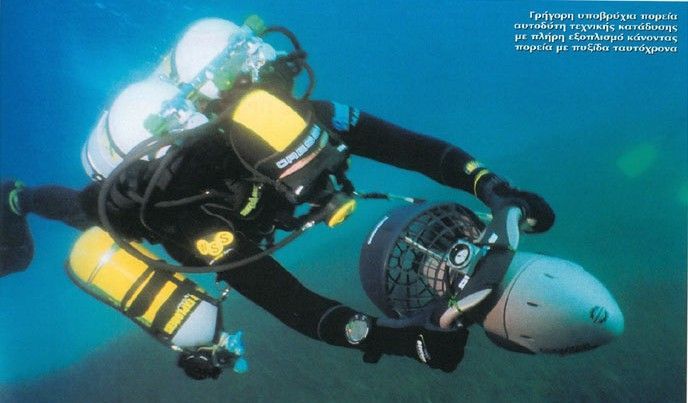
Looking now at the wonderful DPVs (Diver Propulsion Vehicle) that exist, the one in the article seems so inadequate but it was what we had available at the time. Of course, it was the approach for the amateur scuba diver and not for the technical scuba diver. It was a DPV that allowed the scuba diver to train and travel long distances without fatigue.
The essential part of a scuba diver's dive is their underwater path.
It is this phase of diving during which it swims underwater:
• either because he wants to reach a specific point by taking a quick and at the same time exploratory look, usually by swimming faster than normal...
• either because it enjoys the underwater environment, usually swimming slowly... seeking beauty, surprise... a shipwreck, a reef, a school of dolphins...
• είτε διότι θέλει να επιστρέψει σε ένα συγκεκριμένο σημείο συνήθως κολυμπώντας γρηγορότερα από το φυσιολογικό... εδώ η ματιά είναι λιγότερο εξερευνητική και περισσότερο στραμμένη σε παράγοντες ασφάλειας.
Σε αυτή την υποβρύχια κολύμβηση διακρίνουμε τα εξής στοιχεία:
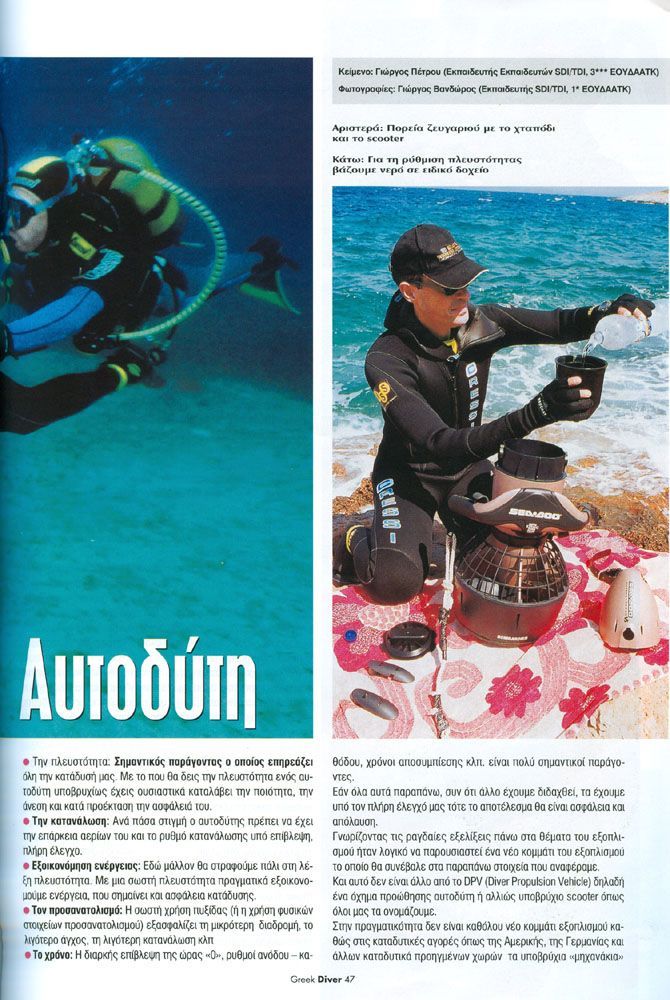
• Buoyancy: An important factor that affects our entire diving experience. Once you “see” the buoyancy of a scuba diver underwater, you have essentially understood its quality, comfort and, by extension, its safety.
• Την κατανάλωση
Ανά πάσα στιγμή ο αυτοδύτης πρέπει να έχει:
- την επάρκεια αερίων του
- το ρυθμό κατανάλωσης...................υπό επίβλεψη / πλήρη έλεγχο.
• Energy saving Here, our focus should probably go back to the word buoyancy. With proper buoyancy, we actually save energy, which also means diving safety.
• Orientation. The correct use of a compass (or the use of natural elements of orientation) ensures the shortest route, the least stress, the least consumption, etc.
• Το χρόνο
Η διαρκής επίβλεψη της Ώρας «0», ρυθμοί ανόδου - καθόδου, χρόνοι αποσυμπίεσης κλπ είναι πολύ σημαντικοί παράγοντες.
If all of the above, PLUS everything else we have learned, are under our complete control then the result will be: SAFETY & ENJOYMENT.
Γνωρίζοντας τις ραγδαίες εξελίξεις πάνω στα θέματα του εξοπλισμού ήταν λογικό να παρουσιαστεί ένα νέο κομμάτι του εξοπλισμού το οποίο θα συνέβαλε στα παραπάνω στοιχεία που αναφέραμε.
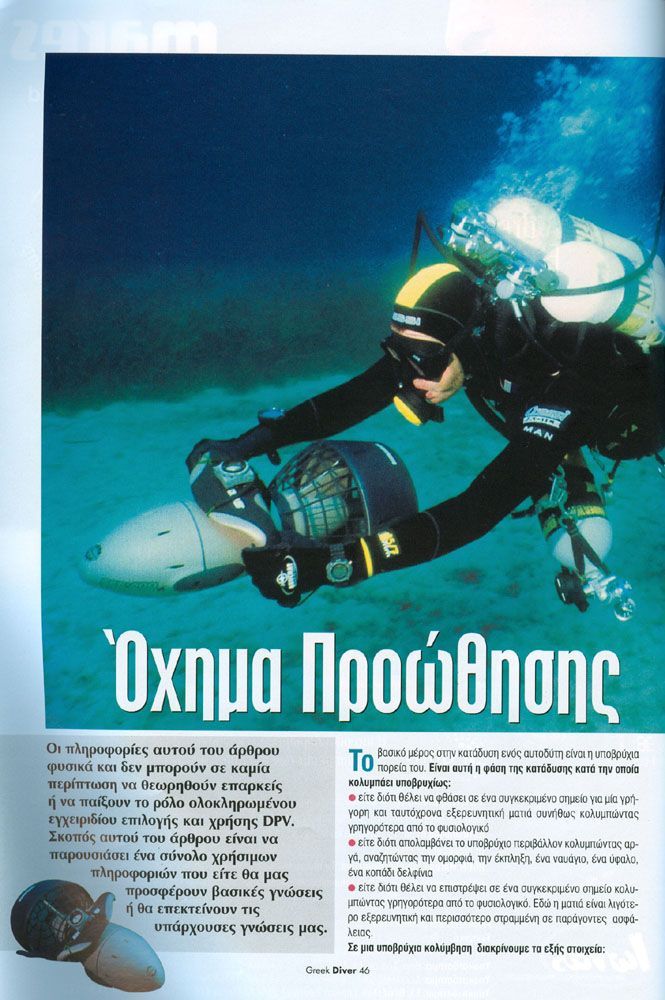
And this is none other than the DPV (Diver Propulsion Vehicle), or Underwater Scooter as we all call them.
In fact, it is not a new piece of equipment at all, as in diving markets such as America, Germany and other diving-advanced countries, underwater scooters have been around for years. Many countries produce remarkable scooters such as the USA, Germany, Japan, China, Taiwan, etc.
Its use undoubtedly relaxes the scuba diver because he no longer needs to paddle, but rather it pulls him towards the direction and point he desires. Its use itself is a pleasure in itself. Since underwater scooters have been quite perfected in terms of construction and the cost is very affordable, their use is becoming more and more widespread.
What is a scooter?
Scooter ή DPV (Diver Propulsion Vehicle) ή Όχημα Προώθησης Αυτοδύτη, είναι αυτό που λέει η ίδια η πρόταση, ένα σύστημα προώθησης του αυτοδύτη υποβρυχίως. Δηλαδή ένα υποβρύχιο μηχανάκι το οποίο διαθέτει προπέλα και μπορεί να κινείται μεταφέροντας έναν αυτοδύτη υποβρυχίως.
Είναι χρήσιμο και ασφαλές? Βεβαίως ΝΑΙ. Είναι ασφαλές , απολαυστικό και σαφέστατα πολύ εξυπηρετικό.
Let's look at it first from a constructional perspective.
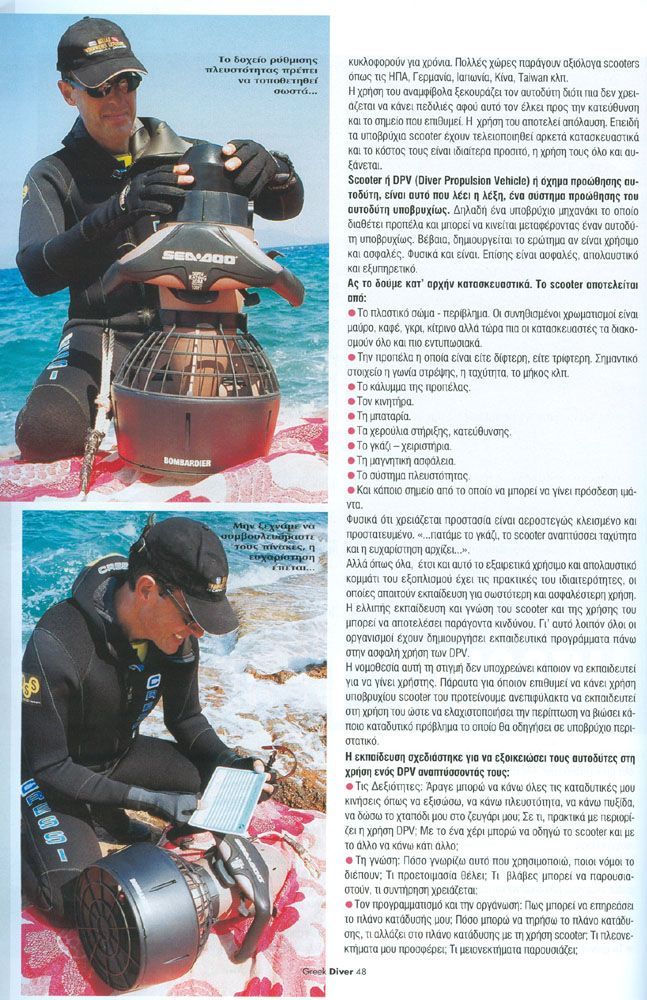
The scooter consists of:
• The plastic body - casing, this plastic is extremely elastic and highly durable. The usual colors are black, brown, gray, yellow but now manufacturers are decorating them more and more impressively.
• The propeller, which is either "two-bladed" or "three-bladed", the angle of rotation, speed, length, etc. are important elements.
• Το κάλυμμα της προπέλας
• The engine
• Την μπαταρία
• The support and steering handles
• Throttle - controls
• Magnetic safety
• The buoyancy system
• And a point from which a strap can be attached
• Of course, everything you need is airtight and protected
"...we step on the gas, the scooter picks up speed and the pleasure begins...".
But like everything, this extremely useful and enjoyable piece of equipment has its practical quirks, quirks that require someone to be trained in it for its most correct and safest use.
...insufficient training and knowledge of the scooter and its use can be a risk factor...
For this reason, all organizations have created training programs on the safe use of DPVs.
The law currently does not require anyone to be trained to become a user. However, for anyone wishing to use an underwater scooter, we strongly recommend that they be trained in its use in order to minimize the chance of experiencing a diving problem that will lead to an underwater incident.
The training was designed to familiarize divers with the use of a DPV by developing:
• Skills
"Can I do all my diving movements such as equalizing, buoyancy, compassing, giving my octopus to my partner? What, in practice, does using a DPV limit me to? Can I drive the scooter with one hand and do something else with the other?"
• knowledge
"How much do I know about what I'm using, what laws govern it? What preparation does it require? What damage can occur, what maintenance is needed?"
• Planning & Organization
"How can it affect my dive plan? How long can I stick to my dive plan, what changes in the dive plan with the use of a scooter? What advantages does it offer me? What disadvantages does it present?"
• the procedures "What will change in my diving procedures?"
• the techniques "What technical uses of this (scooter), if I don't get trained, I'll probably experience them at a time when I shouldn't...and I don't want that at all..."
• the problems What problems arise from using a scooter? Logically, everything should be easy,...hm... but is that so?... of course not...there are problems that we need to be aware of.
• and the risks of using a DPV and most definitely not in a rooftop environment...
"Ποίοι είναι οι κίνδυνοι χρήσης ενός DPV?"
• and finally all the many "Safety, Enjoyment, Service..."
ΟΙ ΜΥΘΟΙ ΤΩΝ SCOOTER
(Truths / Lies)
Air injection
Decompression Sickness
Air Embolism (Lung & Head Airspace Trauma):
Along with the positives, however, there are also negatives = risks arising from the misuse of scooters, such as the risk (very small in reality) of barotrauma due to a quick dive or ascent with it. The scooter has the characteristic of "faster" movement of the scuba diver. As long as this is done at a constant - desired depth, there is no problem. However, a problem can arise if, due to one of our movements, the head of the scooter turns up or down and the scuba diver in this quick change of depth does not have time to equalize the air spaces. He quickly emerges or dives a few meters.
Fortunately, this is an extreme case whose probability of occurring is minimal because:
1. The speed of modern scooters for amateur use is such (it is correct, that is, a speed that is satisfactory - fast as required without reserving rapid movements - accelerations) that it will hardly trouble or push the scuba diver in such a direction.
2. The properly trained scuba diver will not find himself in this phase on the one hand, but on the other hand, he will not either hold his breath (lungs) or fail to equalize the air spaces of the head.
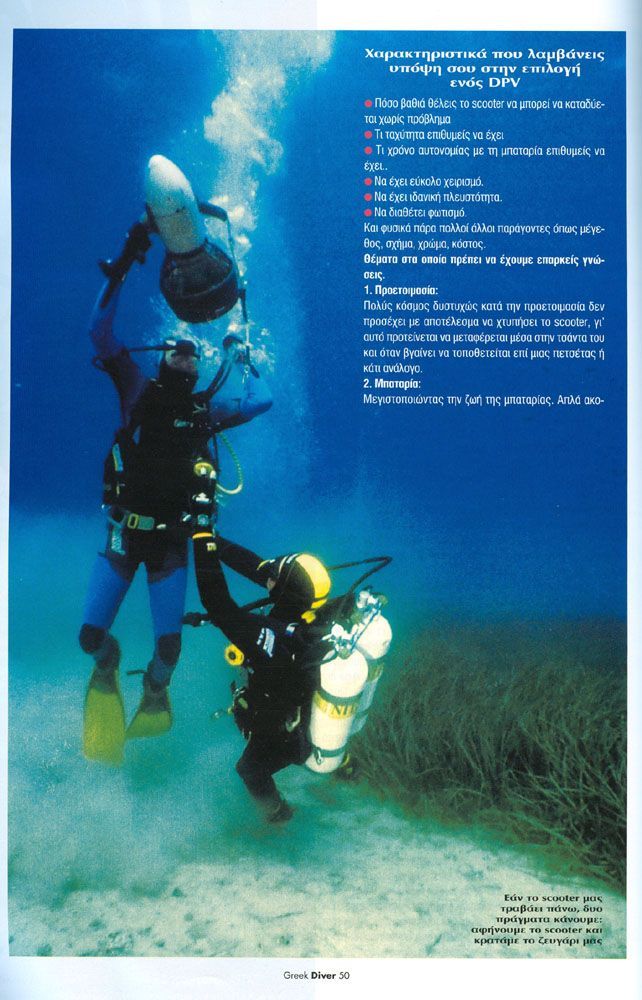
3. In the extreme case where the scooter "takes" him up or down, the diver has nothing else to do but to let go of the throttle and it will stop immediately. "It is important for the diver to be aware of the issue of Pressure Equalization and Pressure Difference."
Decompression Sickness
Now on the other hand some have mentioned and raised the issue of Disease. The scooter cannot affect a scuba diver who knows how to use it properly, it cannot cause a rapid ascent in the scuba diver unless he himself desires it or makes mistakes.
Για παράδειγμα ο αυτοδύτης έχει δεθεί με ιμάντα, και ενώ το γκάζι από εμπλοκή "κολλάει" λόγω της πρόσδεσης τον "τραβάει" πάνω... Πρακτικά εάν αυτή η εμπλοκή συμβεί απλά οδηγούμε εμείς το scooter στην κατεύθυνση που επιθυμούμε και ταυτόχρονα λύνουμε το πρόβλημα...ο σωστά εκπαιδευμένος και έμπειρος αυτοδύτης αντιμετωπίζει εύκολα ένα περιστατικό.
Σπάνια ένα scooter ευθύνεται για Νόσο των Αυτοδυτών.
Let's not discuss it any further.
"It is important for the scuba diver to be aware of the issue of dive computers and charts and not to relax because of the exciting scooter. We must constantly monitor the pressure gauge, depth gauge, Dive Computer, Charts, our mind must always be engaged with all the basic safety factors."
Features to consider when choosing a DPV.
The following factors come into play here:
• How deep do you want the scooter to be able to dive without a problem...
• What speed do you want it to have...
• What battery life do you want it to have...
• Be easy to handle...
• Να έχει ιδανική πλευστότητα...
• It should have lighting in case...
Of course, there are many other factors... such as size, shape, color... and of course... cost...
Topics that we must have sufficient knowledge about.
A.
Προετοιμασία
Unfortunately, many people are not careful during preparation, resulting in scratching the scooter, which is why it is recommended to carry it in your bag and when you take it out, place it on a towel or something similar.
B.
Battery
Μεγιστοποιώντας την ζωή της μπαταρίας. Απλά ακολουθήστε τις οδηγίες φόρτισης - αποφόρτισης του κατασκευαστή.
Λεπτομέρεια: όταν το scooter ευρίσκεται εκτός νερού η μπαταρία πρέπει να είναι αποσυνδεμένη.
C.
Maintenance
Of course, rinse it with fresh water. Clean off dirt, apply grease where necessary, check clips and joints.
D.
Storage
Αποθηκεύεται με αποσυνδεμένη μπαταρία σε σκιερό, αεριζόμενο σημείο, μακριά από την πρόσβαση των παιδιών.
AND.
Transport
Transportation must always be done in the company's carrying bag.
F.
Βλάβη οχήματος
We must be seriously concerned about what we will do at any time during the dive in case the scooter malfunctions. Therefore, a little practice in simulating such situations under the supervision of an instructor is very useful.
G.
Avoiding propeller jams and obstructions.
It is very important that nothing hangs or protrudes above us to avoid getting caught or tangled in the propeller.
H.
Use of companion system
Practicing a simulated pair collaboration either: - Walking holding each other in a walk. - Walking with an octopus...
I.
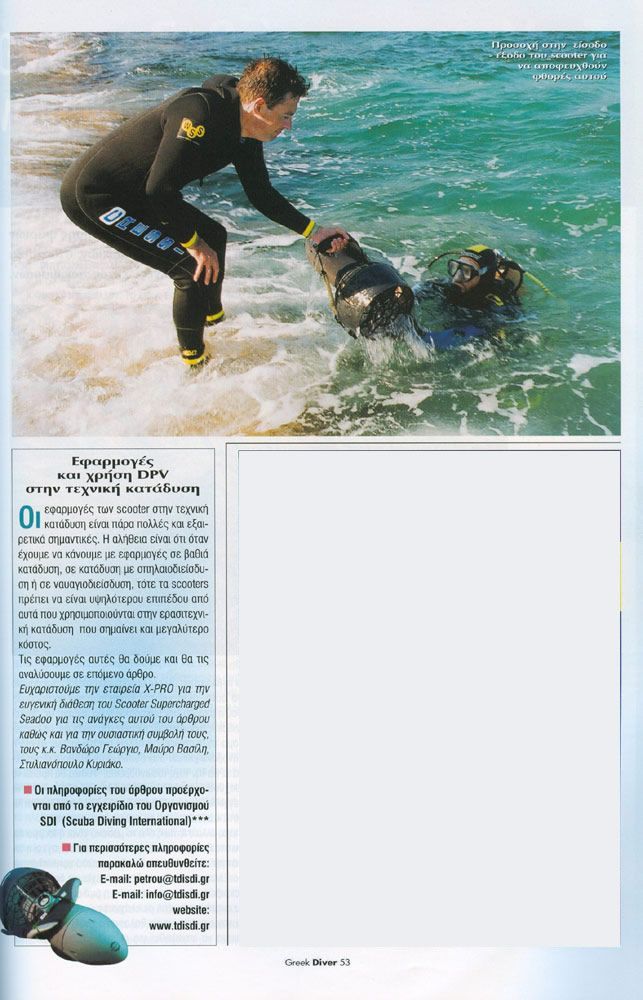
Entry, exit from the water.
Be careful not to hit or scratch your scooter... so it's a good idea to work with your partner, or with your surface support.
J.
Using DPV on the surface
Στην επιφάνεια? Βεβαίως...το scooter σε πάει γρήγορα και ξεκούραστα. Γιατί να χαλάω αέρα για να φθάσω στο αγαπημένο μου καταδυτικό σημείο?
K.
Driving with hitch
Having an attachment point is essential for practical reasons. In a suspended position it will be very uncomfortable to hold it in your hand.
L.
Orientation procedures
Είναι σημαντικό εάν το περιβάλλον το απαιτεί να έχουμε πάνω του μία πυξίδα (εάν δεν θέλουμε να την έχουμε στο χέρι). Προσωπικά την προτιμώ στο scooter.
M.
Διαδικασίες αναδύσεων, καταδύσεων
I recommend that the user practice vertical ascent under the supervision of an instructor.
What about air consumption?
• Using the scooter can cause a free flow of the pressure regulator and result in a loss of gas.
• Can using a scooter change our gas efficiency data?
Imagine traveling a long distance quickly and comfortably, e.g. 200 meters (length) and suddenly the scooter breaks down, do we have enough gas now that we have to swim back to cover such a distance?
Of course, the solution is always the shortest - namely the vertical emergence into the blue for the surface. Here there are at least two not so insignificant "details":
- Most scuba divers unfortunately have serious problems with vertical ascent and proper buoyancy without the scooter, what will they do now with an additional accessory?
- What happens if the diver has a long decompression time?
- What happens if the incident occurs while the diver is in a ceiling environment, i.e. inside a cave or shipwreck?
Setting a return point
Εδώ ισχύει πάλι η περίπτωση που αναφέραμε παραπάνω:
Σκεφτείτε να διανύσουμε γρήγορα και ξεκούραστα μια μεγάλη απόσταση π.χ. 200 μέτρα (μήκος) και ξαφνικά το scooter χαλάει, έχουμε επάρκεια αερίου τώρα που πρέπει να επιστρέψουμε κολυμπώντας έχοντας να διανύσουμε μια τέτοια απόσταση?
So to anticipate such a case we must have defined in advance:
- a minimum gas pressure (such that if our scooter is damaged, our air is sufficient to allow us to carry the scooter.) - maximum distance
DPV Applications and Use in Technical Diving The applications of scooters in technical diving are very many and extremely important. The truth is that when we are dealing with applications:
- Σε βαθιά κατάδυση
- Σε κατάδυση σε Σπηλαιοδιείσδυση ή σε Ναυαγιοδιείσδυση
then the scooters must be of a higher standard than those for use in recreational diving, which also means a higher cost.
We will see and analyze these applications in a future article.
We thank the company X-PRO for kindly providing the Supercharged Seadoo Scooter for the needs of this article.
Publications
Share this